A green stucco house can feel light and understated in pale sage, warm in olive, or bold in forest green. The best shade depends on the roof, windows, brick, and stone that will remain on your home. Start with those materials, then choose a green that connects them.
The following 16 ideas show different ways to combine green stucco with trim, roofing, and architectural details. They include options for updated Colonials, ranch homes, coastal houses, and contemporary designs suited to New Jersey neighborhoods.
Treat these palettes as starting points. A photograph can help you choose a direction, but the final color should come from a physical sample of the proposed finish.
16 Green Stucco Color Combinations to Consider
The color names below describe general shade families rather than exact paint formulas. For each idea, compare the suggested palette with the permanent materials on your own home.
1. Sage Green Stucco with Warm White Trim
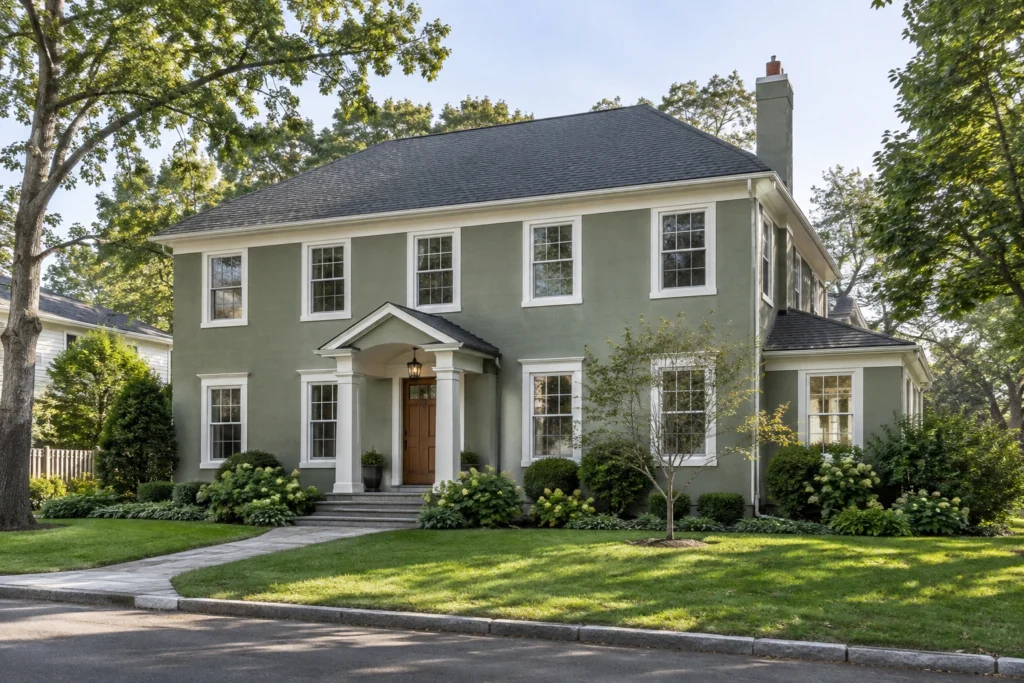
A sage green stucco house with warm white trim is a useful starting point for an updated Colonial. The muted green gives broad wall areas some color, while pale window surrounds and a simple portico keep the facade easy to read.
Pair it with a charcoal shingle roof and a natural wood front door. Keep the white consistent across the fascia, porch columns, and window trim.
Watch the undertone of existing white windows. A noticeably creamy trim sample may look yellow beside bright white factory frames.
2. Light Sage with Black Window Frames
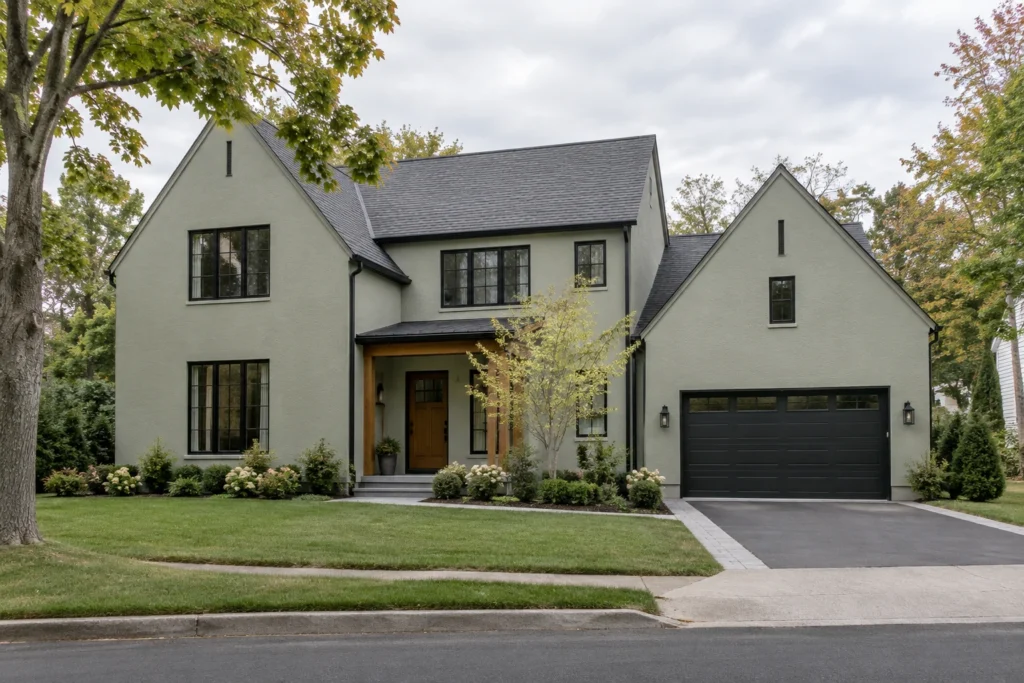
Light sage works well on a modern farmhouse with simple gables and generous windows. Black frames create definition without requiring heavy decorative trim.
Use light sage on the main stucco walls, a dark gray roof, and restrained wood accents around the entry. Let the window frames supply most of the contrast.
If the house already has many small windows, avoid outlining every opening with wide black bands. Thin frames and quiet wall surfaces will make the composition easier to follow.
3. Gray-Green Stucco with a Charcoal Roof
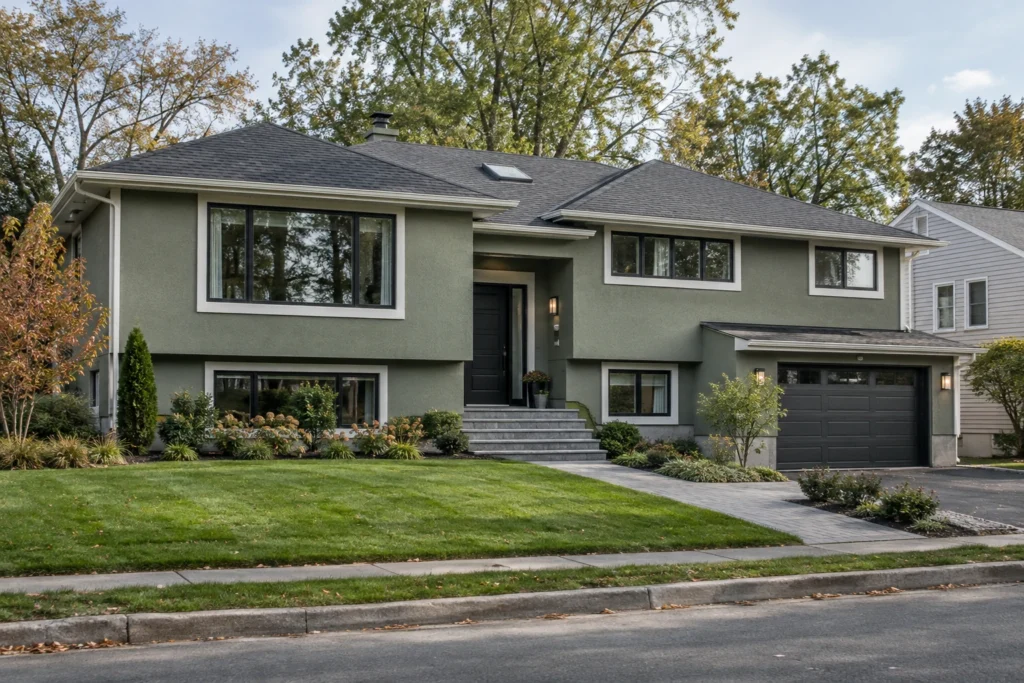
Choose gray-green when you want more color than a gray exterior but still prefer a restrained palette. It can connect a charcoal roof with gray paving and an existing concrete or stone foundation.
This combination suits a renovated split-level or a contemporary home with long horizontal lines. Use soft white trim if the facade needs definition, or medium gray trim for a closer tonal match.
Test the green beside the actual roof. A roof that appears neutral from the street may reveal blue or brown tones at closer range.
4. Warm Olive Stucco with Brown Shingles
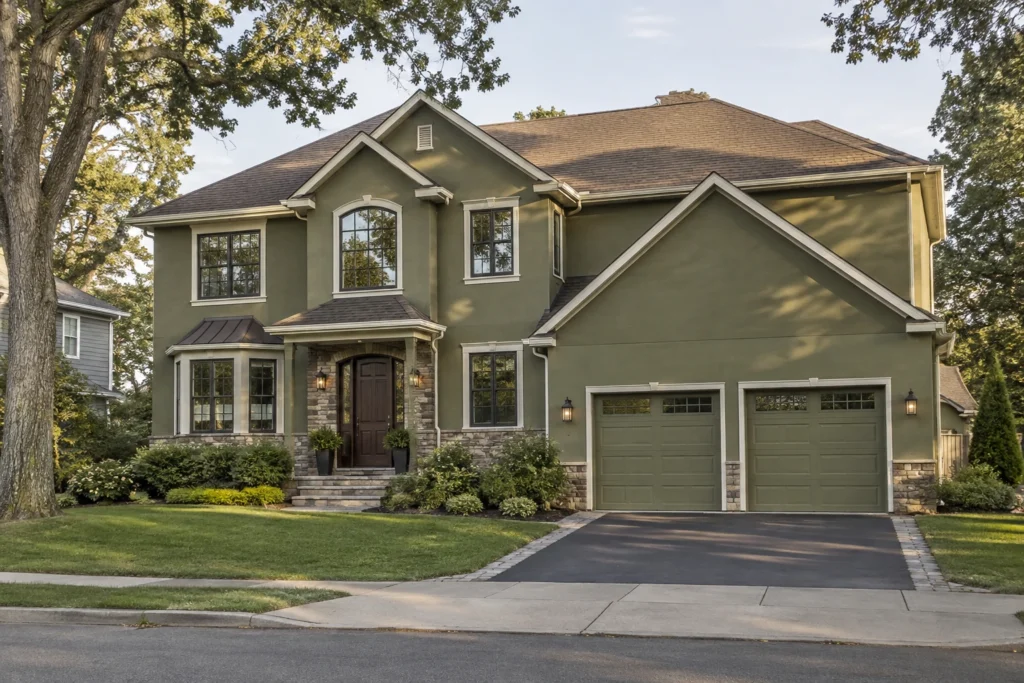
An olive green stucco house is worth considering when a brown roof will remain in place. Olive’s warm character can connect the roofing with tan masonry and bronze fixtures.
Try cream trim and a dark brown entry door. On a large two-story house, keep the garage doors close to the wall color so they do not dominate the front elevation.
Some olives lean strongly yellow. Compare them with the roof and any beige stone before choosing a full facade color.
5. Deep Olive with Cedar Entry Accents
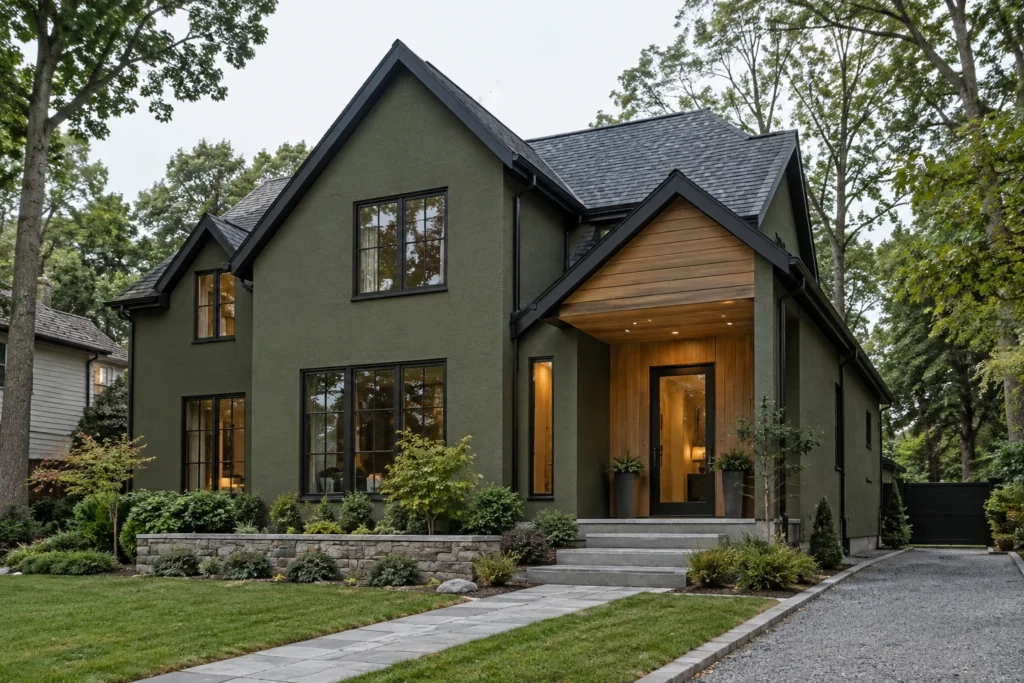
Deep olive and natural cedar create a strong combination for a contemporary house with a recessed entrance. Use the green across the main stucco walls and reserve cedar for the entry surround or a sheltered porch ceiling.
Black windows and a charcoal roof keep the remaining palette simple. The wood becomes the warm focal point.
Avoid adding several unrelated wood stains. The front door, porch ceiling, and nearby fence should look intentional together, even if they are not identical.
6. Forest Green with Cream Trim
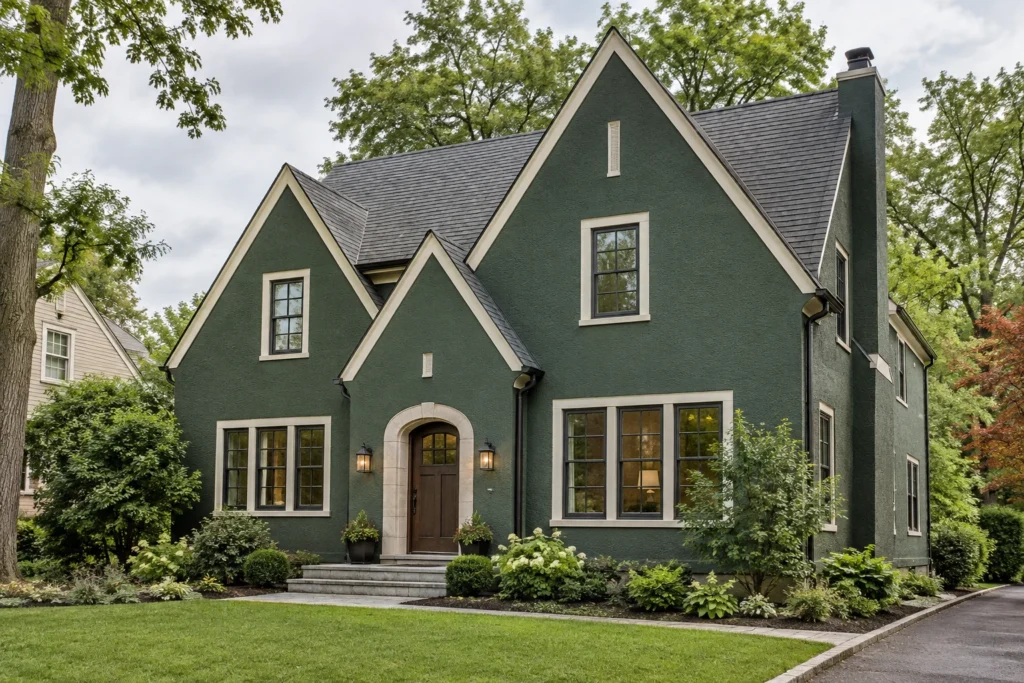
Forest green gives a steep-gabled house a more pronounced outline, particularly when paired with cream window surrounds and fascia. It can work on an updated Tudor-inspired home without adding decorative half-timbering.
Choose a dark gray roof and a restrained dark brown door. Keep the cream on architectural features that deserve attention.
A dark green stucco house can look much heavier beneath deep eaves. Review samples in those shaded areas and check the finish system’s dark-color requirements before committing.
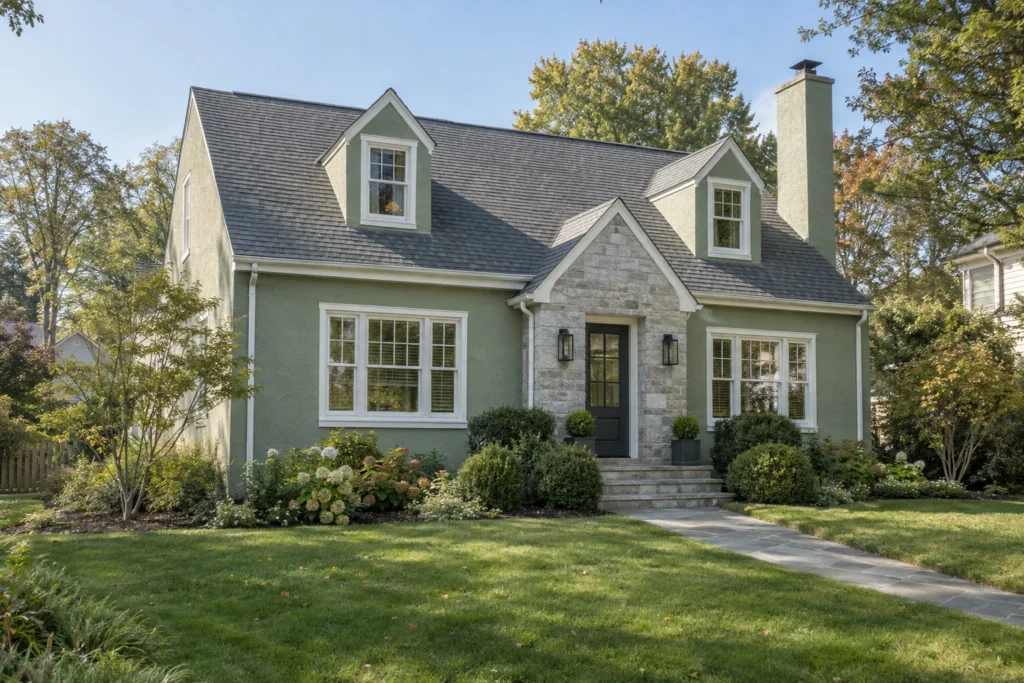
7. Pale Green with Light Gray Stone
Pale green stucco can soften a house with a prominent gray stone entry or foundation. Let the stone supply texture while the stucco provides a quieter background.
This combination works well on a renovated Cape Cod with a medium gray roof and simple white window trim. Keep the stone concentrated around the entrance or lower facade.
Check whether the stone contains blue, beige, or lavender tones. A green that looks balanced beside one gray stone may feel disconnected from another.
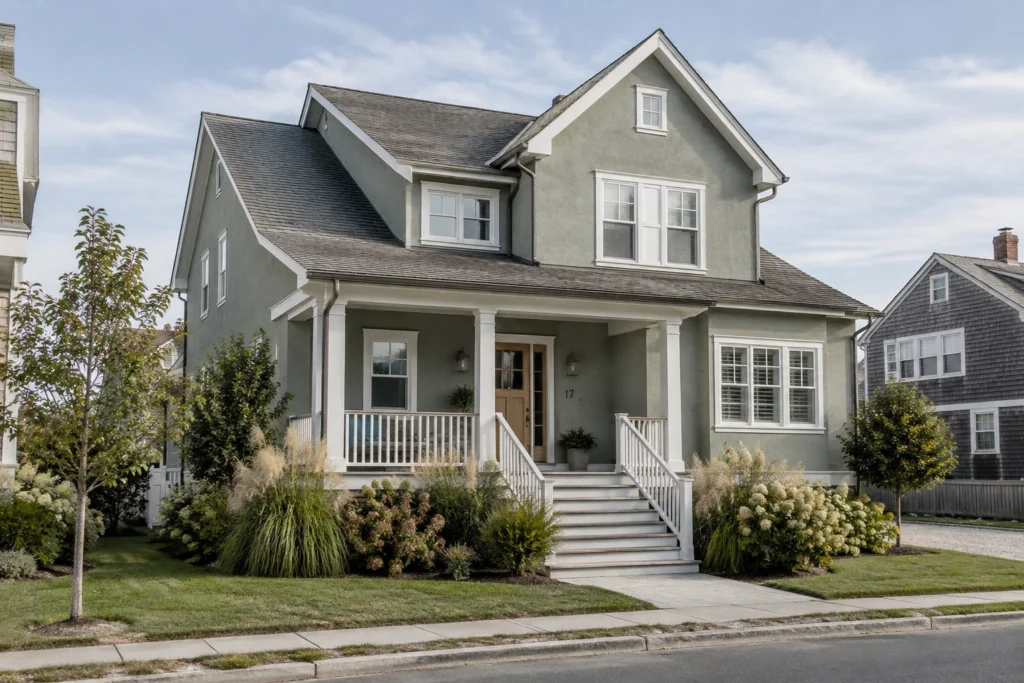
8. Silvery Green with White Coastal Details
A silvery green exterior offers a restrained option for a coastal house. Pair it with white porch rails, white windows, and weathered gray roof shingles.
Use a muted shade with enough green to remain visible against the trim. A pale wood door can add warmth without making the palette busy.
For a New Jersey coastal setting, think in terms of familiar residential proportions, practical porches, and local landscaping. The color does not need tropical details to feel appropriate near the shore.
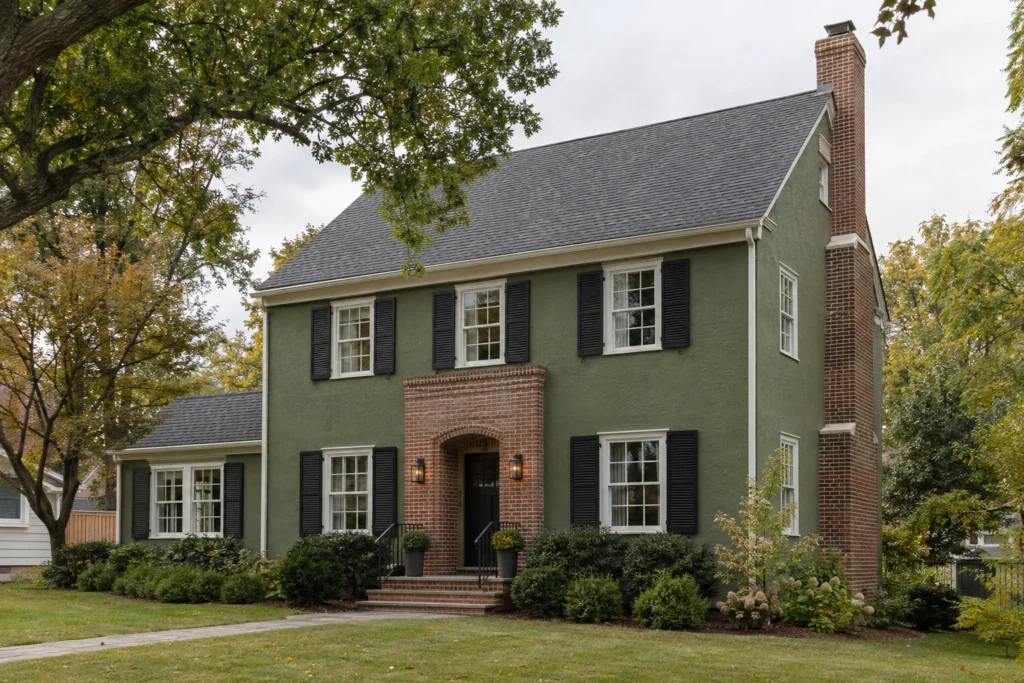
9. Moss Green Stucco with Existing Red Brick
If your home combines brick and stucco, use the brick as the starting point. A muted moss green can create a pleasing contrast with red brick while keeping both materials visually distinct.
Consider warm off-white trim and a charcoal roof. Leave the brick visible around an entrance, chimney, or lower wing.
Highly saturated red and green can compete for attention. Choose a quieter green and compare it with the mortar as well as the brick faces.
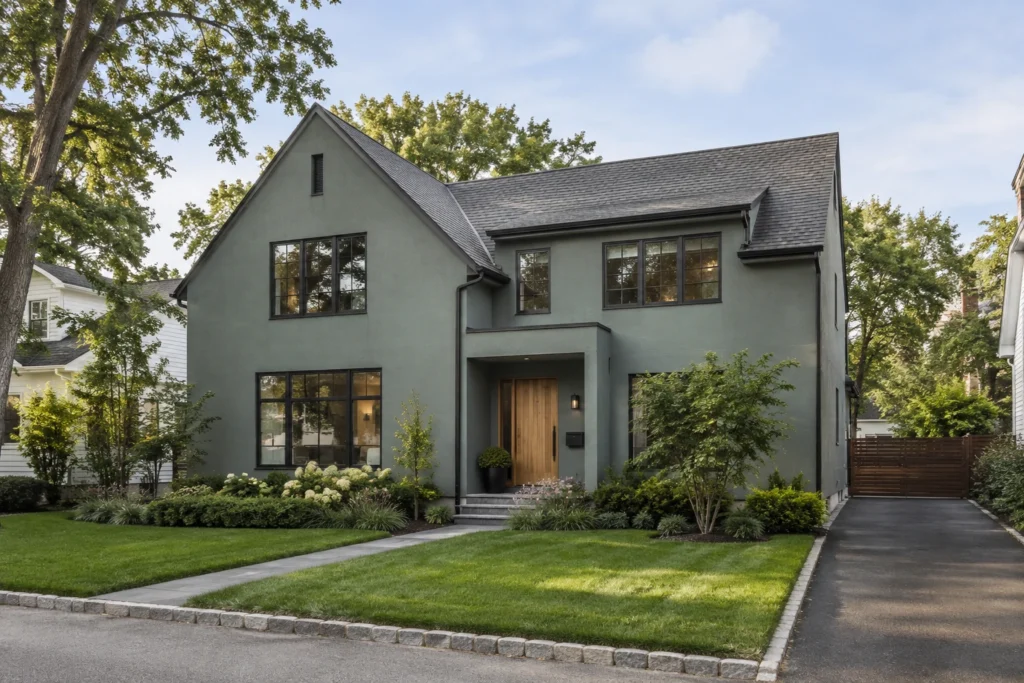
10. Eucalyptus Green with Bronze Windows
A muted eucalyptus green, with a slight blue-gray character, can work with dark bronze windows on a contemporary home. Bronze provides definition with a softer appearance than stark black.
Pair the walls with a medium gray roof and a small amount of natural wood at the door. Keep decorative trim minimal.
This palette deserves careful sampling if the house also has warm tan stone. The green should connect with the stone rather than make it appear unusually orange.
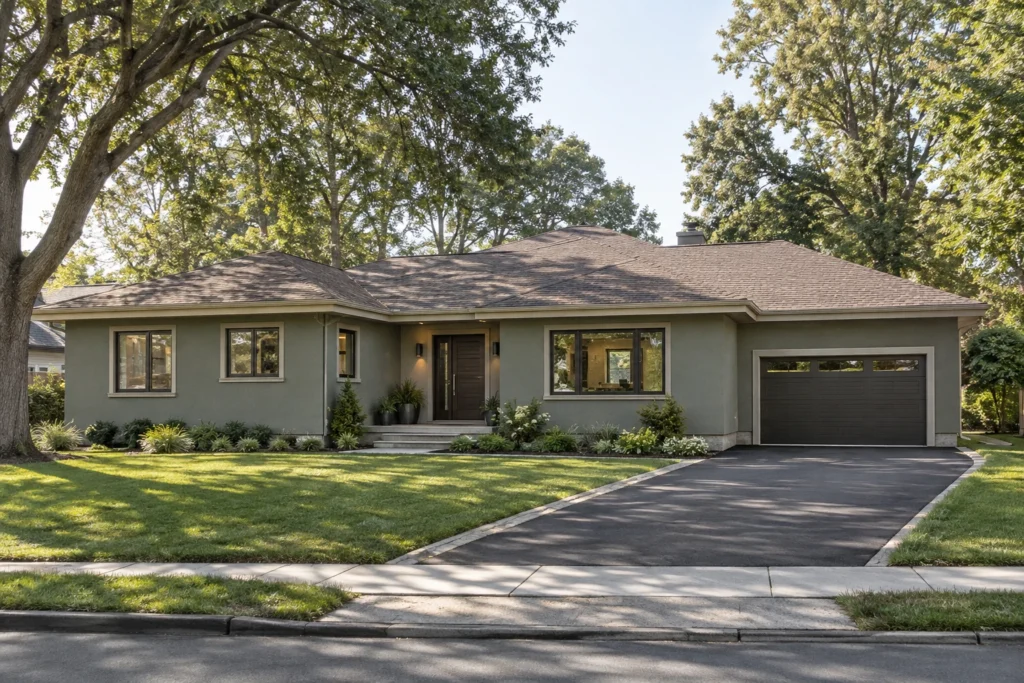
11. Dusty Green with Taupe Trim
Dusty green and taupe create a subtle combination for a ranch home. The closer contrast helps the long roofline and wall surfaces read as one composition.
Use a brown-gray shingle roof and a darker wood door to give the entrance some definition. Carry the taupe onto the fascia and selected trim rather than introducing another pale neutral.
Avoid choosing wall and trim colors that are almost, but not quite, the same. Either create a visible difference or deliberately use one color across both surfaces.
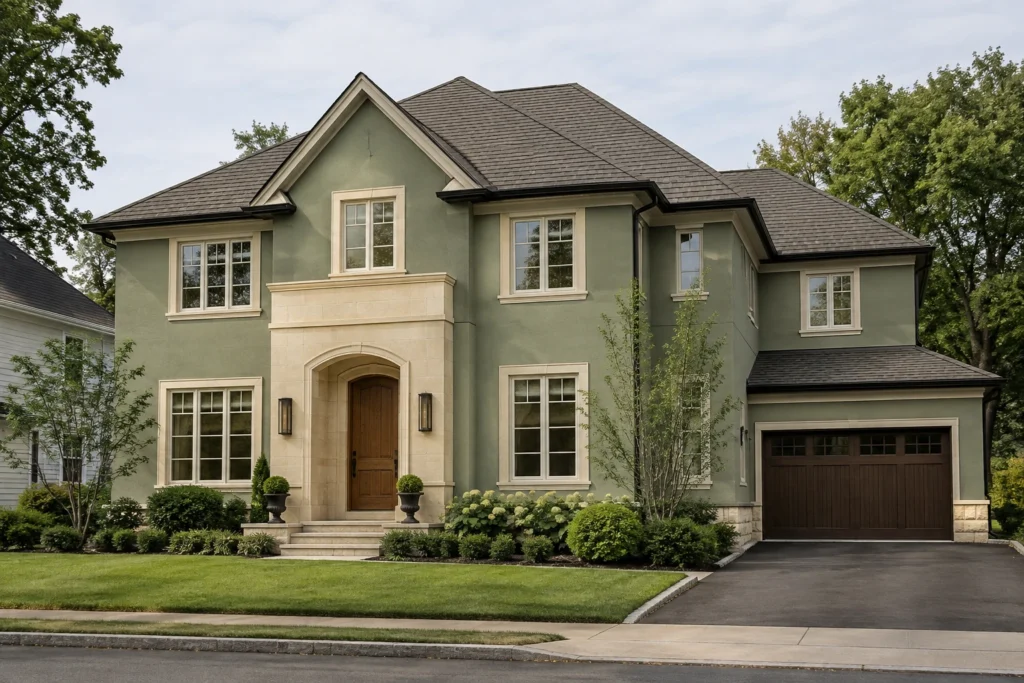
12. Sage Green with a Buff Limestone Entry
Sage green can provide a quiet background for a buff limestone entrance. This is a useful approach on a two-story house where the entry surround is already the main architectural feature.
Combine the green with warm white windows and a brown-gray roof. Keep additional stone accents limited so the entrance retains its emphasis.
Compare the sample against the actual limestone. Creamy, sandy, and peach-toned stones can each change which sage looks most balanced.
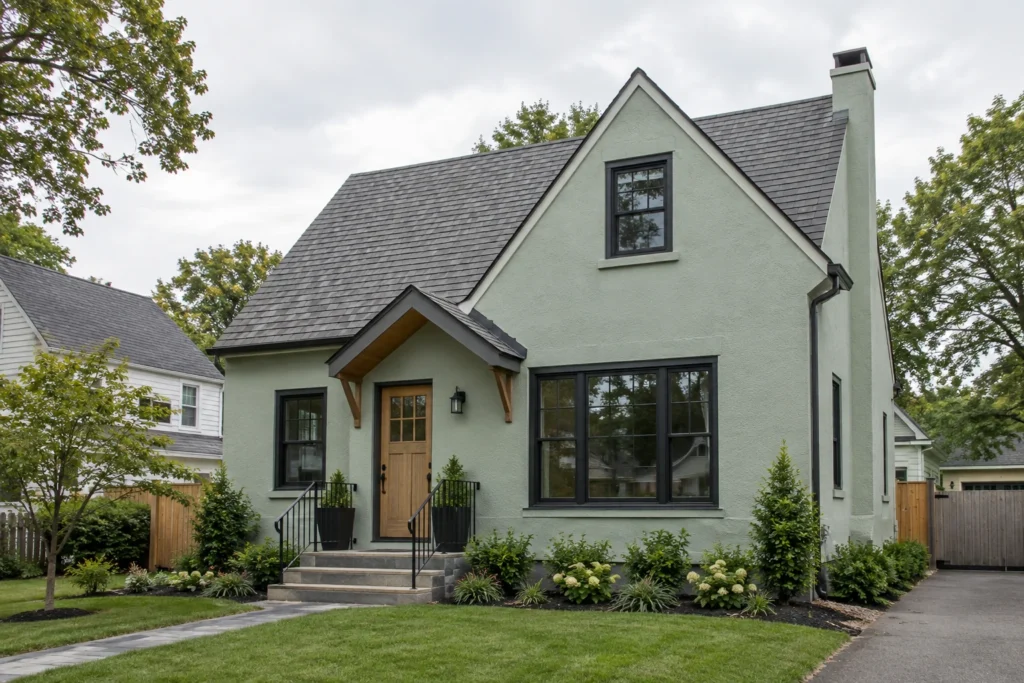
13. Soft Mint with Charcoal Accents
A light green stucco house can feel fresh without becoming overly bright. For a compact Cape Cod or a small contemporary home, try a softened mint with charcoal window frames and a medium gray roof.
Use simple trim and a pale wood door. The dark accents give the light walls enough definition.
Choose a muted mint rather than a vivid pastel if you want a restrained result. Test it across a larger area, where its blue or yellow character will be easier to judge.
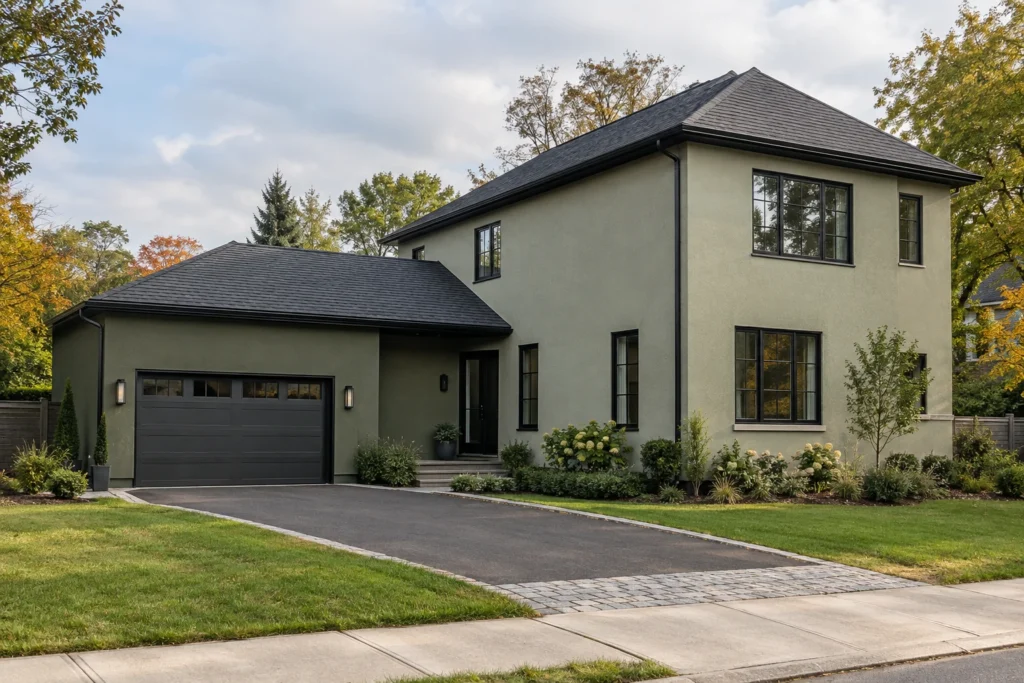
14. Two-Tone Sage and Olive Stucco
Two greens can help distinguish separate parts of a house. Try pale sage on the main two-story section and a deeper olive on a lower garage wing or recessed addition.
Use one window-frame color and one roof color across both sections. Those shared elements connect the different wall colors.
Place the color transition at a real architectural break, such as an inside corner or a change in building height. An arbitrary stripe across a continuous wall can make the facade feel fragmented.
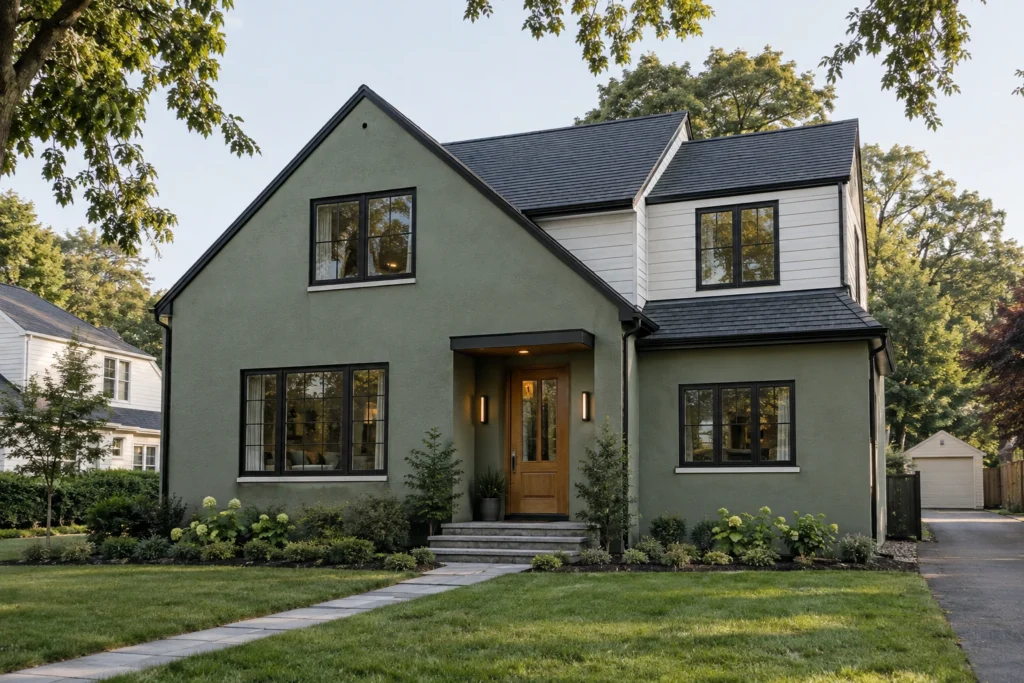
15. Green Stucco with White Horizontal Siding
A mixed-material exterior can combine muted green stucco on the main volume with white horizontal siding on a smaller upper section or addition.
Black windows and a dark roof give both materials a common frame. This approach suits a contemporary renovation where the original house and a new wing have different forms.
Keep one material dominant. If every wall changes color and texture, the house can become visually crowded. Material transitions also need proper detailing, which color selection alone cannot resolve.
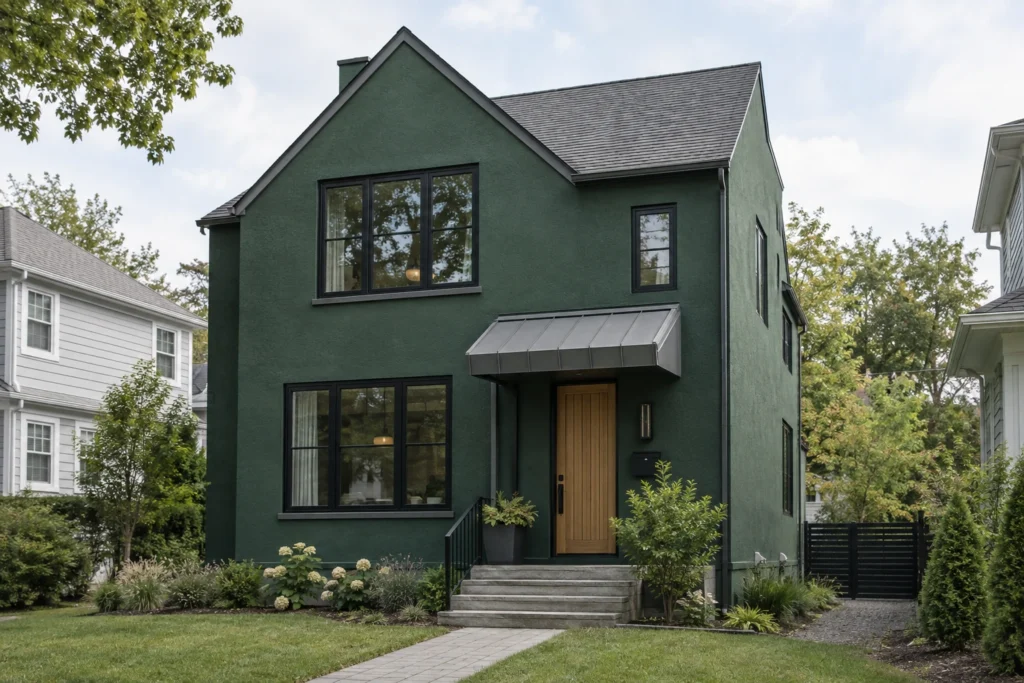
16. Bottle Green with Pewter Metal Accents
For a compact contemporary house, consider bottle green stucco with pewter-colored metal at an entry canopy or a small roof section. The cool metal and deep green create a distinct palette without relying on bright white trim.
Use dark window frames and a warm wood door to complete the combination. Keep the metal accents concentrated around the entrance.
A nearly black green may lose much of its visible color in shade. Compare a slightly lighter alternative, and confirm that the selected finish is suitable for the wall system.
Match the Green to the Materials You Are Keeping
Roofing, masonry, and factory-finished windows often narrow the choices more effectively than a large paint display. Start with the feature that occupies the most visible area and will remain unchanged.
Use this table to decide what to sample first.
| Existing feature | Greens to sample first | What to check |
|---|---|---|
| Warm brown roof shingles | Warm olive, moss, or muted sage | Compare the green with the roof’s brown and red tones, not just its overall darkness. |
| Charcoal roof and black windows | Gray-green, light sage, or eucalyptus | Decide whether you want strong contrast or a quieter transition between walls and windows. |
| Red brick | Muted moss, sage, or earthy olive | View samples beside both the brick and mortar. Avoid choosing from a photograph alone. |
| Cool gray stone | Silvery green, gray-green, or softened eucalyptus | Look for blue or lavender tones in the stone that may affect the combination. |
| Buff stone and cream trim | Warm sage, light olive, or dusty green | Compare the samples with the stone in sun and shade, especially if it contains peach tones. |
| Natural wood accents | Deep olive, forest green, or muted sage | Use a sample of the actual wood finish. Clear, amber, and brown stains create different pairings. |
Check the Finish Before Choosing a Dark Green
Green describes the appearance of a facade, not the material behind it. The visible color may come from a pigmented cement finish, a tinted acrylic finish, or paint applied over a suitable existing surface.
These options are not interchangeable. For example, a cement color coat contains pigment within the finish material, rather than relying on a separate paint layer. The available colors and preparation requirements depend on the product.
Dark shades need particular attention on EIFS, or Exterior Insulation and Finish Systems. Some systems contain foam insulation that limits which finish colors are suitable. LaHabra’s EIFS color guidance advises against colors with a light reflectance value below 20 on EIFS incorporating expanded polystyrene.
That recommendation applies to the specified system, not every stucco wall. Ask the contractor to identify your facade system and confirm the proposed color and coating with its manufacturer.
Test Green Stucco Colors on Your House
Narrow your choices before ordering a full exterior finish. These steps help turn an appealing photograph into a color decision you can evaluate in person.
- Collect the fixed colors. Include the roof, window frames, brick, stone, paving, and any wood finish that will remain.
- Choose three clearly different greens. Compare a lighter option, a warmer option, and a grayer option rather than several nearly identical samples.
- Use the appropriate sample method. Benjamin Moore’s liquid color samples are intended for interior use. Its exterior sampling guidance recommends applying them to white foam board for outdoor viewing.
- Move the samples around the house. Look beside the entrance, beneath the eaves, and on the brightest elevation. Review them at different times of day.
- Approve the actual texture and product. Before the full application, ask for a representative sample made with the proposed material and application method.
A smooth sample board helps narrow the color family, but it does not reproduce every feature of a textured wall. Sto’s finish guidance identifies texture, gloss, and lighting as factors that affect color perception and recommends physical samples and project mockups.
For a broader review of architectural style and surrounding materials, see our guide to choosing your stucco paint color.
Turn Your Favorite Palette into a Project Plan
Choose two or three of the combinations above and compare them with your home’s existing materials. Keep a record of the selected wall color, trim color, product, and approved sample so the installation team is working toward the same result.
For an existing facade, address damaged areas and moisture concerns before treating the project as a color change. A new green finish cannot correct missing flashing or drainage problems.
If you are planning a repaint in New Jersey, explore ZD Stucco Repair’s stucco painting services and bring your shortlisted palettes to the consultation. Ask which preparation, coating, and sample process suit your walls.
Frequently Asked Questions
What color door works with a sage green house?
Natural wood, charcoal, deep navy, and muted terracotta are useful options to sample. Choose according to the role you want the door to play: wood adds warmth, charcoal connects with dark windows, and a contrasting color makes the entrance more noticeable. Test the door color inside the actual entry recess, where shade may change its appearance.
Can you paint stucco?
Yes, suitable stucco surfaces can be painted after appropriate preparation. Existing coatings, cracks, contamination, and moisture conditions affect the work required. Benjamin Moore’s stucco painting guide includes cleaning, repairs, priming, and painting. Follow the selected product’s requirements for curing, surface condition, and application. EIFS needs a coating compatible with the specific system.
What is LRV in paint?
LRV stands for light reflectance value. It describes how much visible light a surface reflects on a scale from 0 to 100. Lower values indicate darker colors; higher values indicate lighter colors. Manufacturers often list it alongside a color, as Benjamin Moore does for Hunter Green. LRV is different from sheen and does not, by itself, establish whether a coating is suitable for your facade.
Does exterior paint look lighter or darker?
It can look either way depending on the light, surrounding materials, texture, and viewing conditions. Direct sun may make a color appear lighter, while a deep porch or shaded wall can make it seem darker. Compare samples on multiple elevations instead of automatically choosing a shade darker than the color you want.
Does dark exterior paint fade faster?
It can, but darkness alone does not determine the rate. Pigment stability, coating quality, sunlight exposure, and surface condition also matter. Fading may be particularly noticeable on a deep green wall, and chalking can make the surface look lighter. Sherwin-Williams’ guidance on fading also identifies unsuitable colorants and excessive tinting as possible causes. Choose an exterior-rated color formula and follow the coating manufacturer’s recommendations.