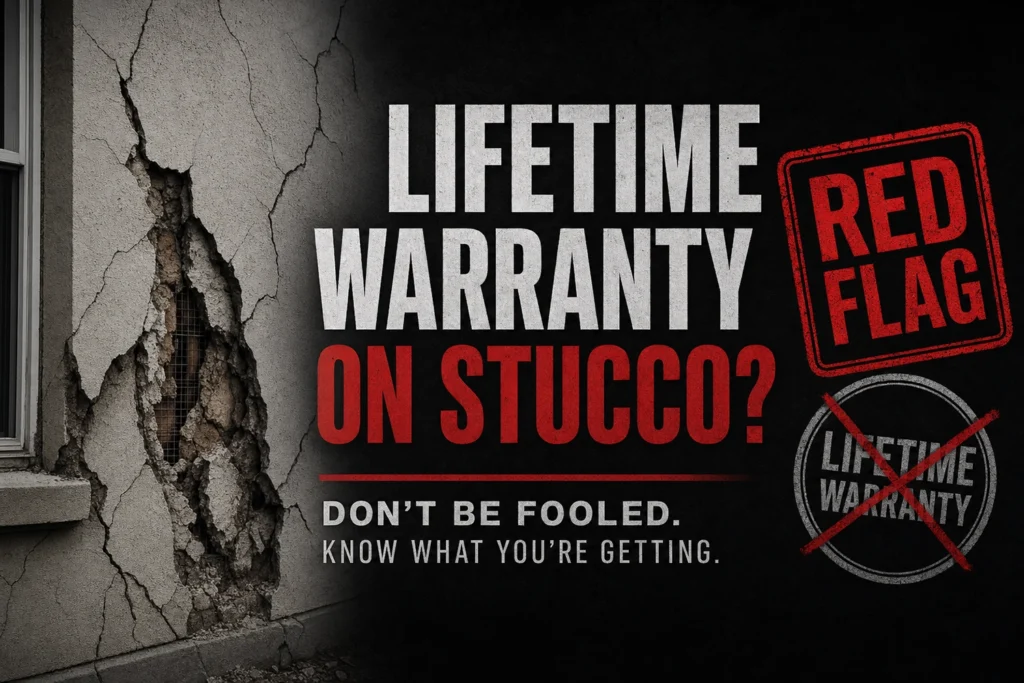
If a stucco contractor gives you a very low price and closes the deal with three magic words, “lifetime warranty included,” stop and slow down. It sounds safe. It sounds responsible. It sounds like the contractor is taking all the risk off your shoulders. In stucco, that is often not what is happening.
A stucco wall is not a static surface that stays frozen in time. Cement plaster moves with heat, cold, moisture, framing movement, and normal building settlement. We see the same pattern in the field: cracking can happen even when stucco is installed properly, and minor cracking around doors, windows, and other stress points should be expected. In NJ, where the weather shifts between wet, dry, hot, and cold, and many areas see regular precipitation through the year, that movement is part of real life, not an unusual event. That is why a “lifetime warranty” on stucco should never be the end of the conversation. It should be the start of a much harder set of questions.
A Real Story We Have Seen Before
A homeowner came to us after choosing a lower bid from another contractor. The selling point was simple: lower price, plus a lifetime warranty. Within a year, the stucco was cracking.
When the wall was opened up, the problem was obvious. The damaged plywood behind the finish had never been replaced. New stucco had been applied over a failing base. The owner still had a “warranty” on paper, but the wall itself was already losing the fight. In the end, the job had to be redone from scratch, and the homeowner paid for the repair twice. That story is exactly why homeowners need to look past the sales line and focus on the actual work.
Why the Promise Sounds Better Than It Is
Stucco is durable, but it is not motionless, and it is not maintenance-free. Technical bulletins on cement plaster say cracking can come from thermal expansion and contraction, building settlement, vibration, impact, loading, and movement in wood framing as it dries. The corners of doors and windows are common crack points. In other words, no honest stucco contractor in NJ can promise that the wall will never need attention again.
Local weather makes that even more true. Rutgers notes that New Jersey weather is highly variable, with average annual precipitation around 40 to 51 inches in different parts of the state, measurable precipitation on roughly 120 days, and clear differences in freeze, snow, and coastal exposure across the state. A stucco wall in this climate goes through wet-dry and hot-cold cycles over and over again. A blanket lifetime promise does not change that.
So when does a lifetime warranty start to sound shaky? Usually, it is used to replace a real discussion about drainage, flashing, sheathing, caulk joints, control joints, or moisture testing. That is a warning sign.
What “Lifetime” Usually Leaves Out
Many homeowners hear “lifetime warranty” and assume it covers the big-ticket failures that hurt the most. In real warranty language, that is often not the case.
Sample manufacturer and contractor warranties commonly exclude lack of maintenance, structural movement, settling, unauthorized alterations, unusual weather, mold, and damage tied to problems outside the warranted product itself. Some also exclude the labor needed to locate the leak source or remove surrounding materials to reach the failure. Other systems split the promise into separate buckets: one limited term for manufacturer materials, another limited term for workmanship, and a narrow remedy limited to the affected area only.
That is the part many owners never hear during the sales pitch.
A wall may be cracking because the framing has moved. Moisture may be entering through bad window flashing, a roof transition, a parapet, failed caulk, or poor grading. Water may be sitting behind the finish and damaging sheathing or framing. If those causes are excluded, then the “lifetime” claim does not protect you from the repair that matters most. It just gives you a nicer sentence on the estimate.
Why Hidden Moisture Damage Changes the Whole Job
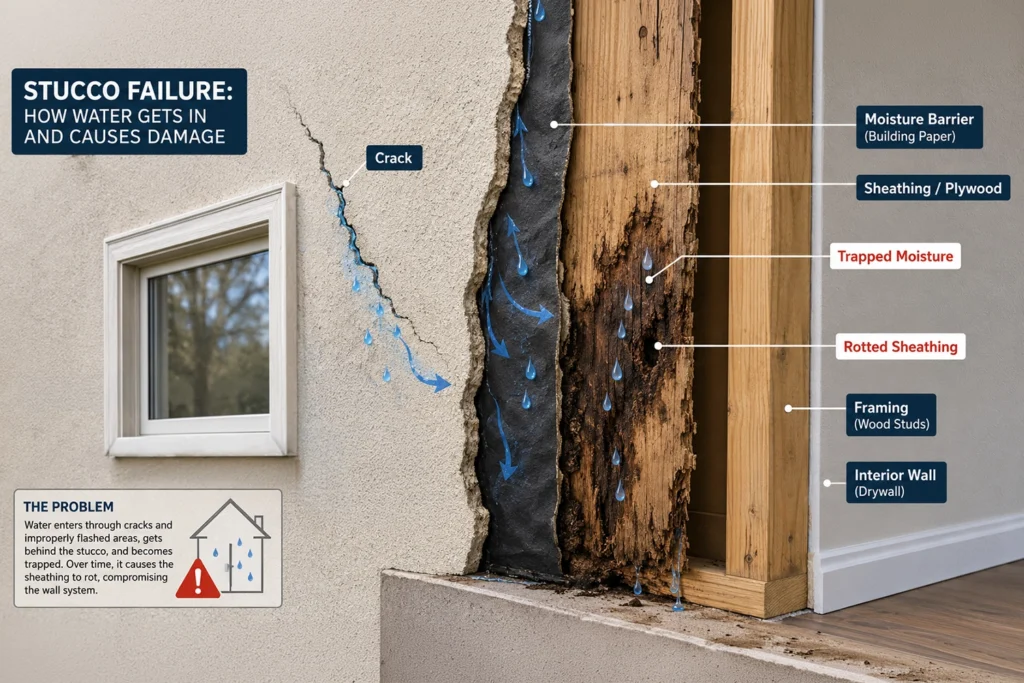
Stucco failures are often not surface-only problems. In real stucco remediation work across NJ, the same issues come up again and again: moisture inspection, hidden damage, structural repair, flashing, drainage, and waterproofing systems. That is not accidental. It is where the real money and the real risk sit.
Before repairing blistering, cracking, or soft areas, the source of water intrusion has to be found and corrected. Otherwise, the same problem can come back. The building-science principle is simple: water needs a path to drain down and away from the building. Proper drainage and flashing are not optional details. They are what help protect the wall system. That means a real stucco repair in NJ is often not just “patch, skim, paint, and go.”
If the sheathing is wet or rotten, it has to be opened and fixed. If flashing is wrong, it has to be corrected. If the wall lacks proper drainage details, the assembly has to be rebuilt the right way. If moisture is trapped behind the finish, simply coating over the surface can make things worse. Coatings and elastomeric paint should not be used as a shortcut when moisture is active, structural movement is ongoing, or the wall system has already failed. Covering the surface can trap moisture and speed up damage. That is why a cheap bid with a flashy warranty can cost far more later. It may only be pricing the visible symptom, not the wall you actually own.
What NJ Homeowners Should Ask Before Signing
Before you sign any stucco contract in NJ, ask these questions plainly:
- Is this a workmanship warranty, a material warranty, or both?
- How many years is it, exactly?
- What is excluded?
- Does it cover moisture testing, tear-out, sheathing replacement, flashing correction, and return visits if the crack comes back?
- What maintenance do I have to do to keep it valid?
- Who honors the warranty if the company changes ownership or closes?
- Will every promise be written into the contract?
Those questions are not overkill. They are basic due diligence.
The New Jersey Division of Consumer Affairs tells homeowners to verify contractor registration, check insurance, and get a written contract for home improvement work over $500. The contract must include the contractor’s legal name, address, registration number, start date, completion date, work description, and total price. The state also says warranties and guarantees should be in writing. That last point matters. If the contractor sells you a “lifetime warranty” but cannot show you the written terms, the exclusions, the scope, and the remedy, then you do not have a working protection plan. You have sales language.
Not Every Stucco Warranty Means the Same Thing
One reason homeowners get confused is that warranty language in the stucco industry is often inconsistent. Some warranties apply only to materials. Some apply only to workmanship. Some depend on the exact scope of work. Some sound broad at first, but become much narrower once you read the exclusions.
That does not always mean the warranty is dishonest. It means homeowners need to understand exactly what is being promised before they sign. A warranty on a small surface repair is not the same as a warranty on full stucco remediation. A product warranty is not the same as a workmanship warranty. A written warranty with clear limits is not the same as a verbal “lifetime” promise. The takeaway is simple: the word “warranty” is not enough. The details are the job.
What Honest Stucco Work Looks Like
A solid stucco contractor in NJ should be able to do five things clearly:
- Inspect the wall and look for the real water path.
- Tell you whether you need repair, partial remediation, or a larger rebuild.
- Show you what is damaged and why.
- Give you a written scope that separates cosmetic work from moisture and substrate work.
- Give you a written warranty tied to the actual work performed, not a vague forever promise.
That is the standard homeowners should expect.
That is the standard we hold ourselves to on every stucco repair and remediation project. Our work is built around the same principles: water infiltration repair, post-inspection remediation, honest repair vs. remediation guidance, clear written scopes, and a written 10-year warranty on new installation work instead of a blanket claim on every stucco problem under the sun.
The Bottom Line
If a bid is low and the warranty sounds too good to be true, pause before you sign. In stucco, the expensive problems are usually not the ones you can see from the driveway. They are the ones behind the finish: bad flashing, active leaks, wet sheathing, trapped moisture, failed drainage details, and repairs that never touched the cause. A “lifetime warranty” does not fix any of that by itself.
Good stucco work in NJ is not built on a magic phrase. It is built on careful inspection, proper moisture control, the right materials, clean installation details, and a written scope that says what is covered and what is not. If you want real peace of mind, ask for the inspection, the photos, the findings, and the contract language. Then choose the contractor who is willing to be direct with you.
If you need stucco repair in NJ and want a real answer, not a sales shortcut, book an inspection with our team and ask for a written scope that deals with the root cause first.ъ