A blue stucco house can feel light and understated, sharply contemporary, or more traditional depending on the shade and surrounding materials. Start with the parts of your exterior that will stay: the roof, windows, brick, stone, and paving. Then choose a blue that works with those surfaces.
Light blue offers a softer contrast with white trim—the painted boards and borders around windows, doors, and roof edges. Blue-gray gives you more color than a neutral gray while staying relatively restrained. Navy creates a stronger contrast with pale trim and natural wood, but with dark colors, your contractor also needs to check that the chosen paint or finish is suitable for your exterior.
The following ideas explore combinations for updated Cape Cods, Colonials, split-level homes, contemporary houses, and small residential buildings. They are design concepts you can adapt to your property.
Start With Your Roof, Windows, Brick, and Stone
A paint sample rarely tells the whole story. A blue that looks balanced beside white paper may look purple beside gray stone or unusually bright beneath a brown roof.
Before comparing blue exterior house colors, identify three things:
- The colors already present in your roof, brick, and stone. Look for hints of brown, gold, red, blue, or green in those surfaces. These subtle hints of another color are often called undertones.
- The contrast you want. Pale blue with white trim creates a quieter transition than navy with white.
- How much of the exterior you plan to paint. A small entry wall can carry a stronger blue than a large wall with few windows or other details.
Use the combinations below as starting points. For a broader approach to coordinating the exterior, see our guide to choosing your stucco paint color.
16 Blue Stucco House Ideas
1. Light Blue Stucco With White Trim
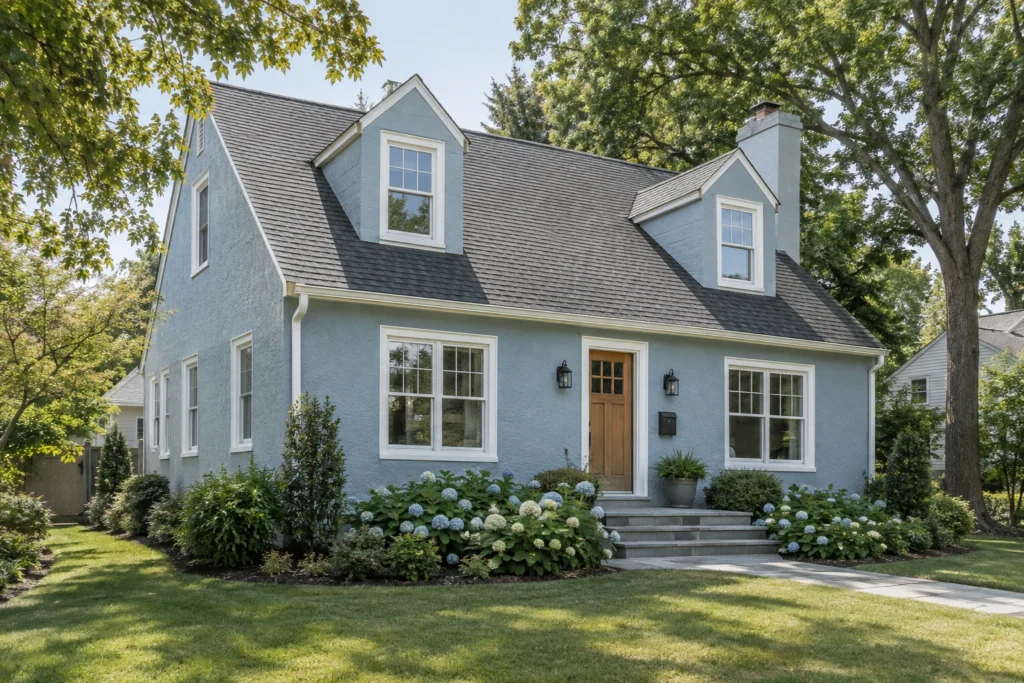
A light blue stucco house with white trim is a useful starting point for an updated Cape Cod. The white outlines the windows and roof edges, while the blue gives the main walls a distinct color without creating a heavy contrast.
Choose a slightly muted blue if you want a restrained result. A very clear pastel can make the same house feel more playful. Keep the roof gray and use a simple wood or white front door so the facade does not depend on several competing accents.
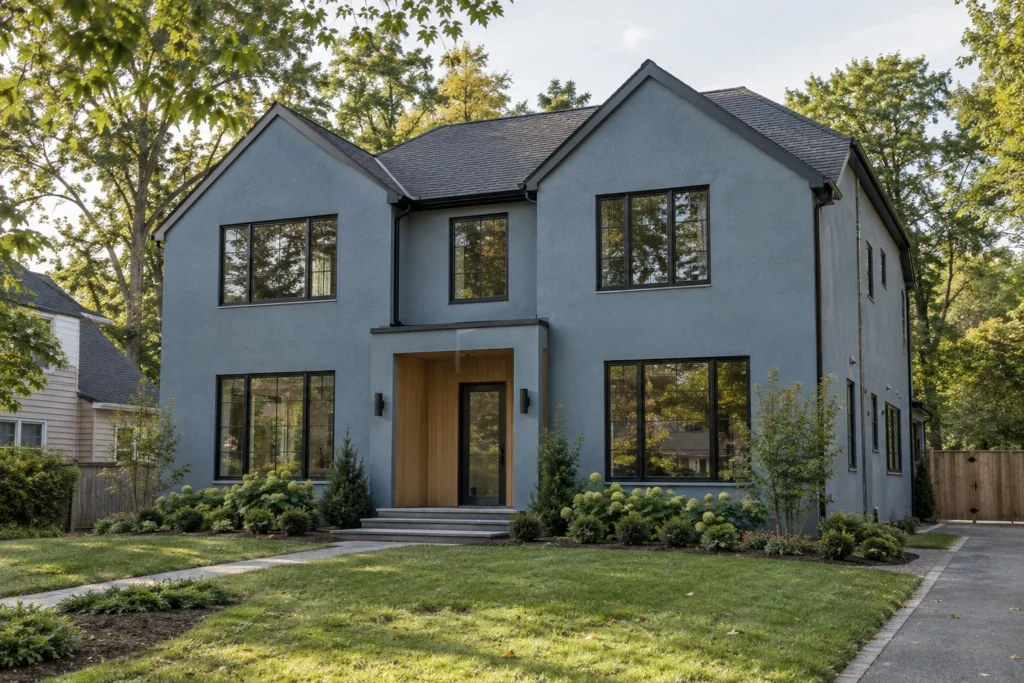
2. Blue-Gray Stucco With Black Windows
A blue-gray house exterior works well with the clean window arrangements of a contemporary two-story home. Black frames define the openings, while the gray component keeps the wall color from becoming overly vivid.
Limit additional black details to a few elements, such as the entry light and railing. Painting every board along the roof edge, door, gutter, and window border black can create more visual weight than the house needs. View the sample beneath an overhang to confirm that it still reads blue in shade.
3. Navy Blue Stucco With Cream Trim
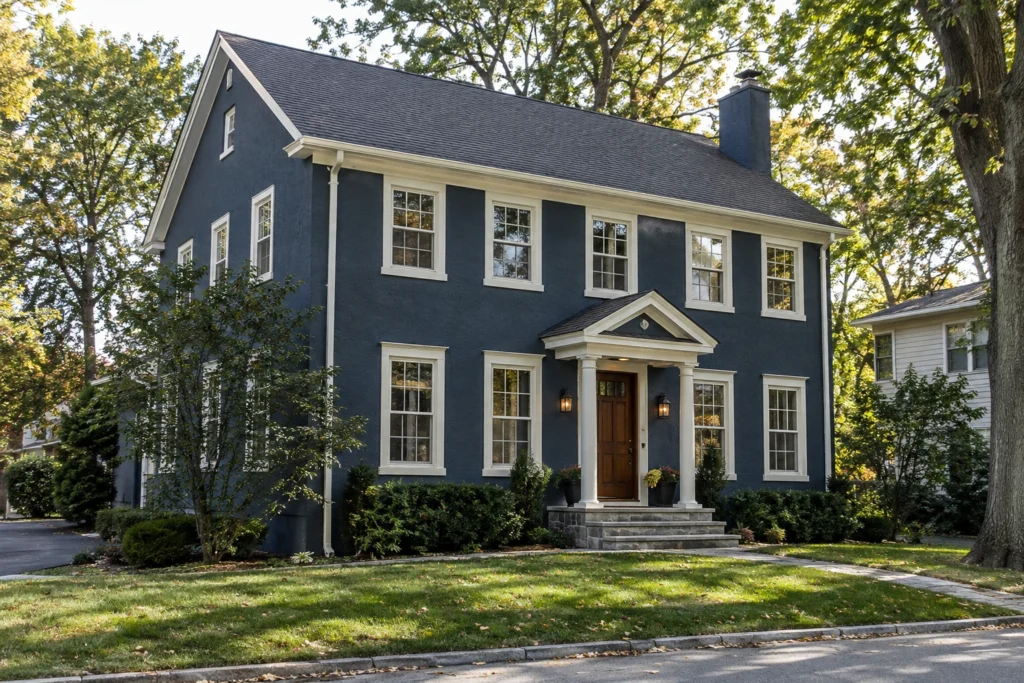
On a Colonial with evenly arranged windows, navy walls help cream-colored window borders and roof trim stand out. Cream can look softer than bright white, particularly beside beige or brown stone steps.
Keep the trim color consistent around the windows, entrance, and roofline. A natural wood door can introduce warmth without adding another paint color. Before committing to a navy blue stucco house, ask your contractor to confirm that the proposed dark shade is suitable for your exterior and the product being used.
4. Slate Blue Stucco With a Cedar Entry
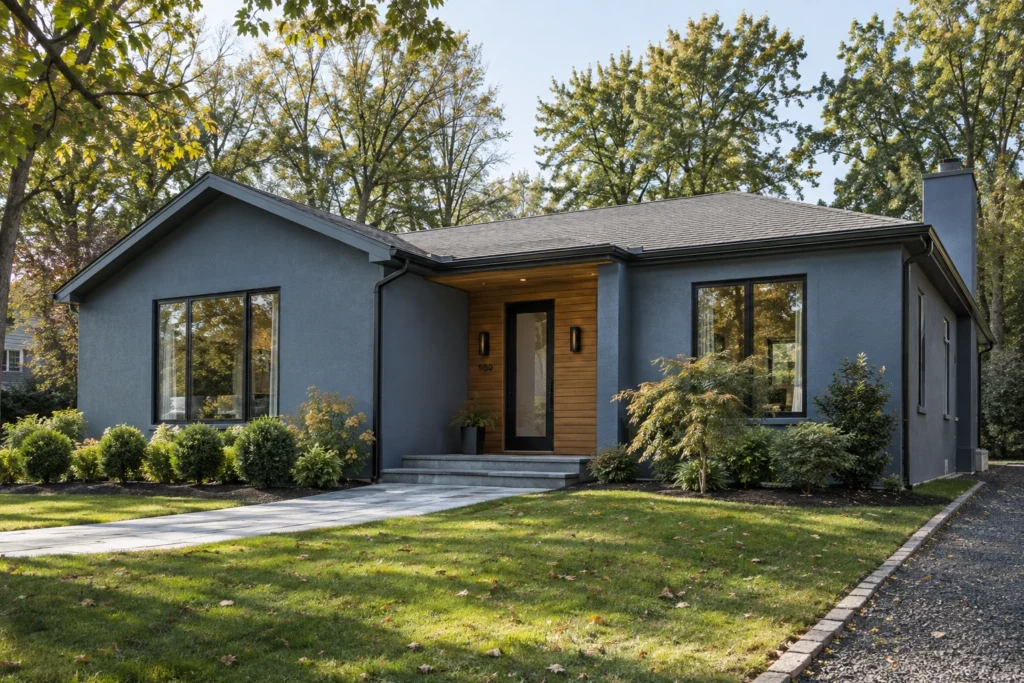
Slate blue and cedar suit a renovated ranch with a clearly defined entrance. Use the blue across the main stucco walls and reserve cedar for an entrance set back from the front wall, a porch ceiling, or a narrow wall beside the door.
That limited placement gives the wood a purpose and helps visitors identify the entrance. Compare the blue against a sample of the actual wood finish. Pale cedar, reddish cedar, and dark stained wood can produce noticeably different combinations.
5. Dusty Blue Stucco With a Brown Roof
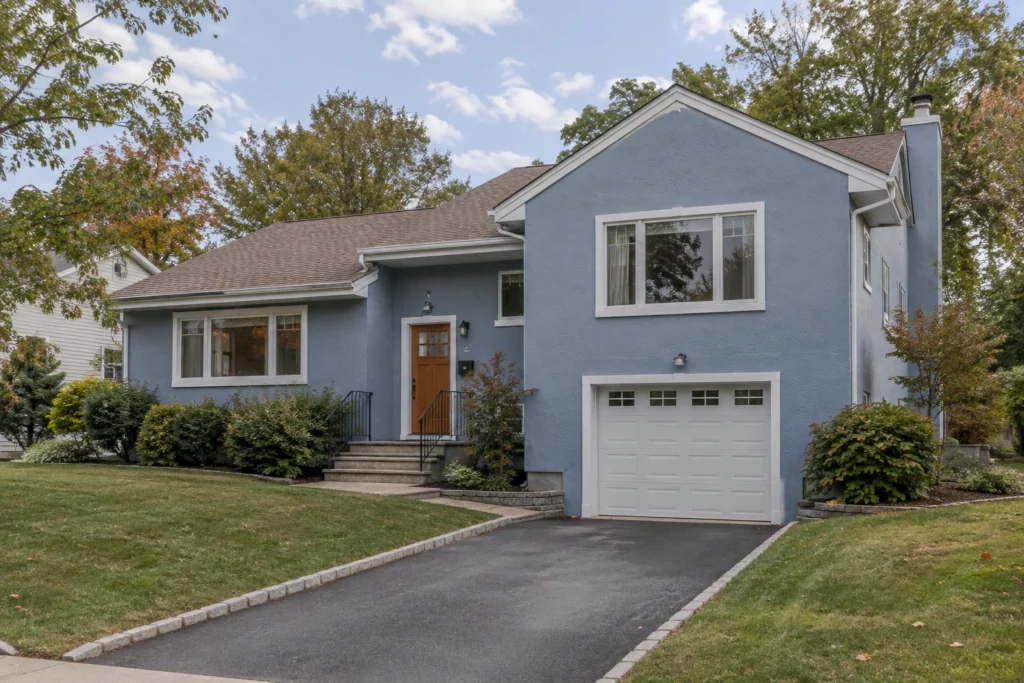
A brown roof does not automatically rule out blue walls. Start by comparing muted blues that contain some gray, especially when the shingles have several brown and charcoal tones.
On a split-level home, soft off-white trim can connect the cool wall color with the warmer roof. Avoid selecting the blue from a screen alone. Place the sample where you can see it beneath the roof edge, then step back far enough to judge both surfaces together.
6. Ice Blue Stucco With Light Gray Details
Ice blue can give a coastal-style house a subtle color change without giving the house a bright beach-house color scheme. Light gray trim and a medium gray roof keep the combination close in tone.
The main challenge is preserving enough contrast. If the trim and walls are nearly identical in brightness, window surrounds may disappear from the street. Test the pair together, and use a slightly deeper door color if the entrance needs more definition.
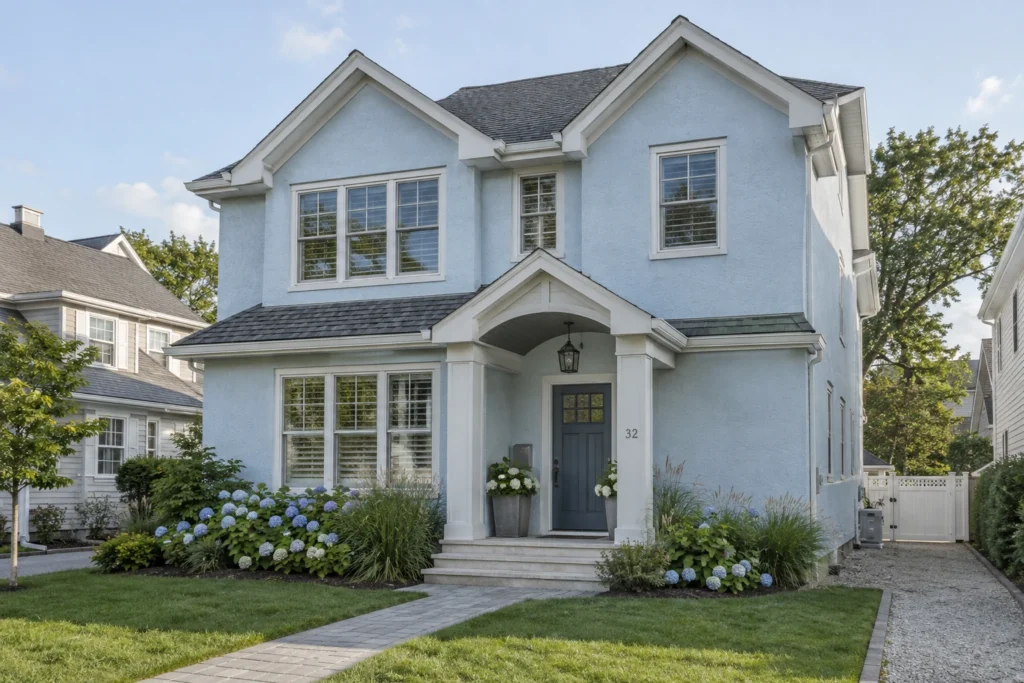
7. Denim Blue Stucco With Red Brick
Denim blue offers a middle ground between pastel blue and navy. Pair it with retained red brick on a chimney, lower wall, or entrance to create a clear contrast between blue walls and the warmer red and brown shades in the brick.
Let the brick guide the trim. Cream may suit brick with orange and tan variation, while a cleaner white may work beside a more uniform deep red. Keep the brick visible in your sample comparison, including the material between the bricks, called mortar, because its color also affects the overall impression.
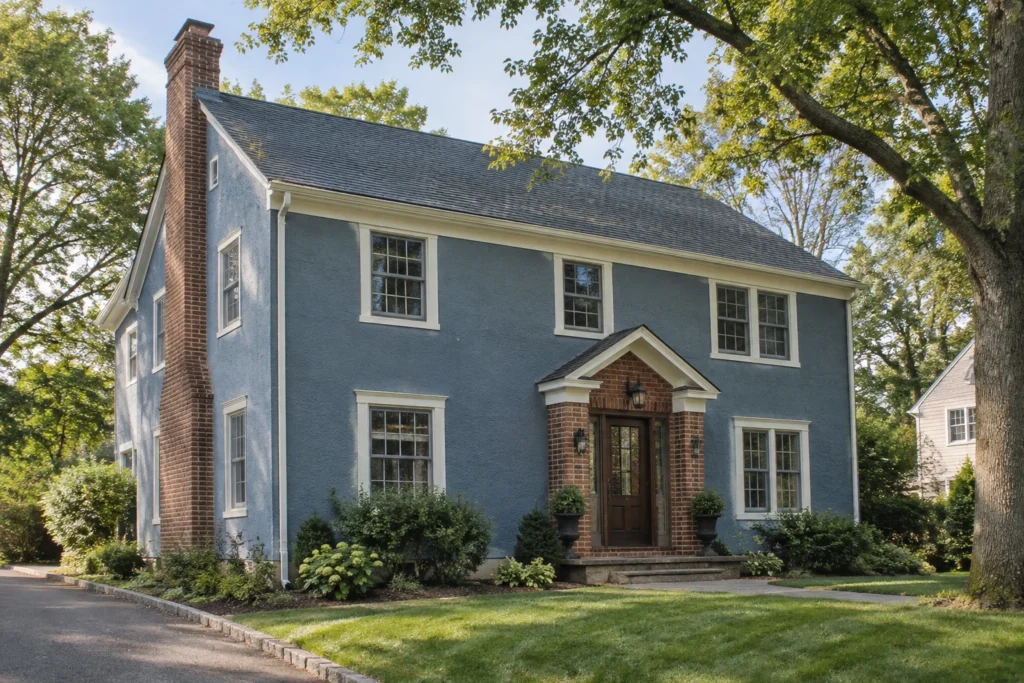
8. Muted Blue-Green Stucco With Bronze Windows
A blue with a subtle hint of green can work beside bronze windows and established landscaping. On a contemporary suburban home, this combination offers color without relying on strong black-and-white contrast.
Choose a sample that still looks predominantly blue if that is your goal. Some blue-green colors shift toward teal beside warm metal or in certain light. Use simple off-white trim and a neutral roof so the window frames and blue walls remain the main color combination.
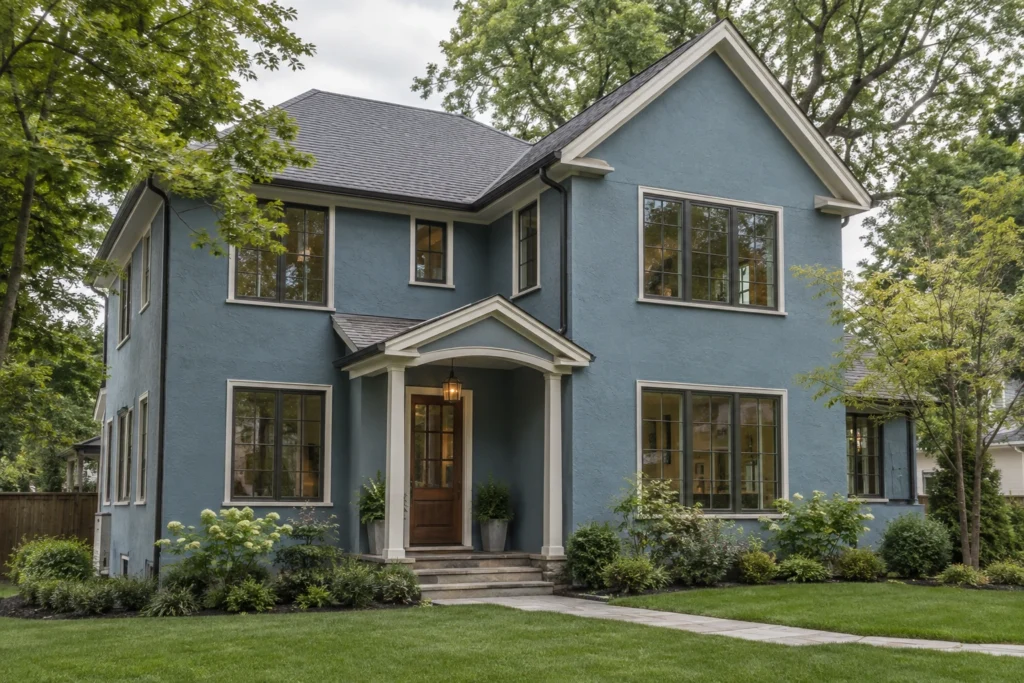
9. Powder Blue Stucco With Limestone
Powder blue and pale limestone can suit a house with a pitched roof and a clearly framed entrance. The stone introduces a different texture while keeping the overall facade light.
Select the stone first if it is already installed or you have decided which stone to use. A creamy limestone and a cool gray limestone may call for different blues. Avoid matching the wall and stone so closely that the entrance loses definition. A wood door can provide a clear focal point within the pale surround.
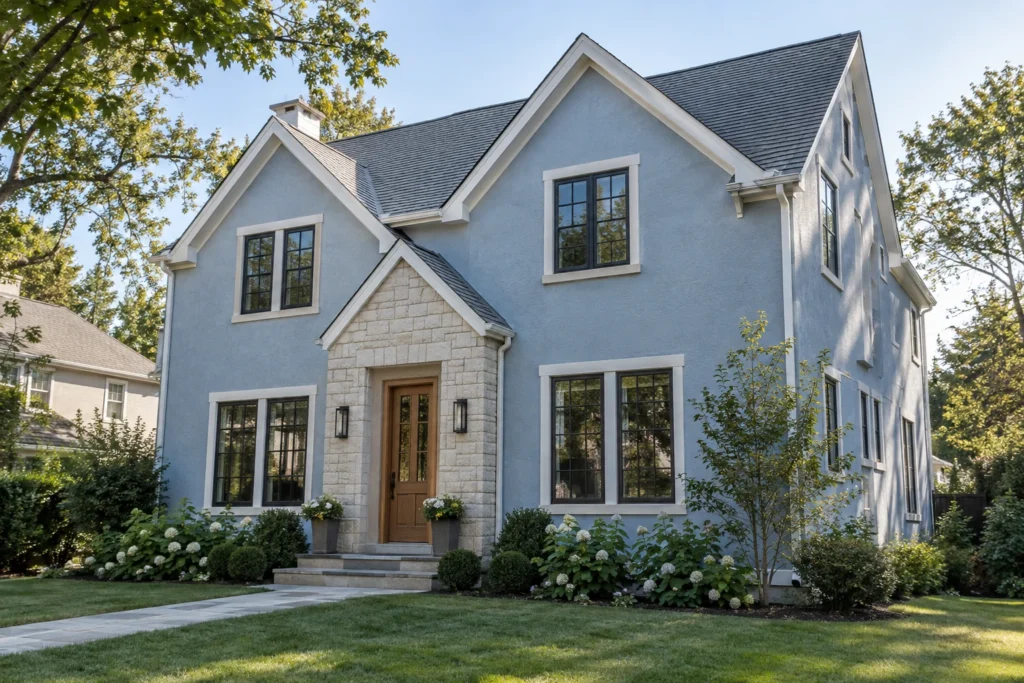
10. Muted Cobalt Stucco With a Natural Wood Door
A medium blue with a cobalt influence creates a more noticeable facade than blue-gray. It can work on a compact contemporary house with simple rooflines and relatively few decorative elements.
Keep the surrounding materials quiet: a charcoal roof, narrow neutral trim, and one wood entrance door. Ask the paint supplier whether the exact shade is available in a product suitable for your exterior. A vivid color offered for indoor walls may not be suitable for outdoor use.
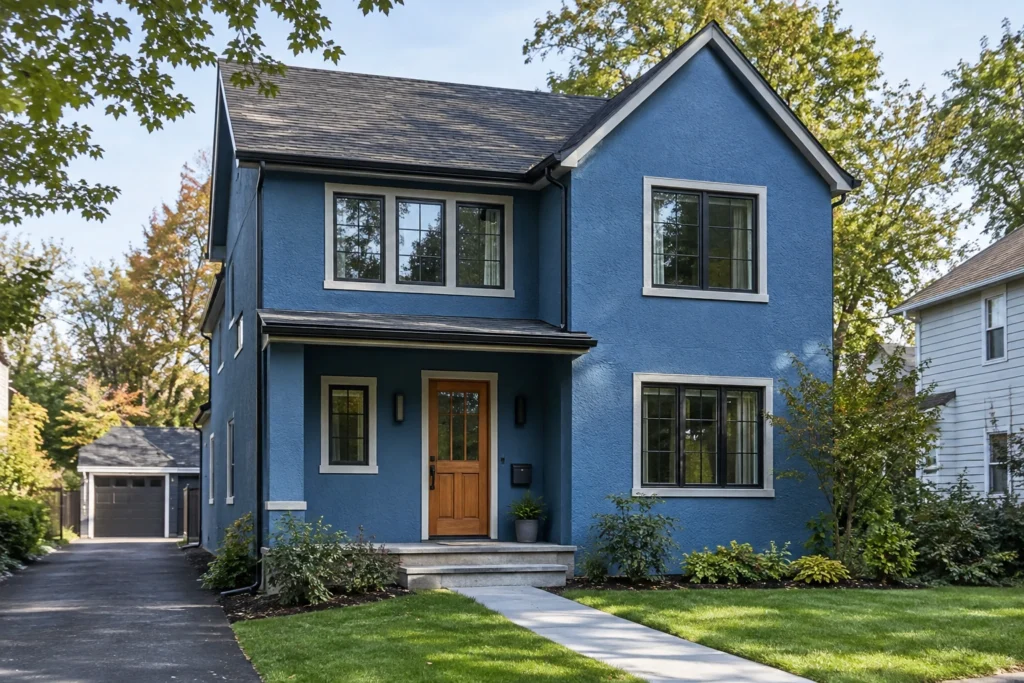
11. Two-Tone Blue Stucco on a Split-Level Home
Two blues can help distinguish the connected sections of a split-level house. Try pale blue on the taller main section and a deeper blue on the lower projecting wing.
Change colors at corners or where a wall steps forward or back. A stripe across the middle of a continuous wall can look out of place. Keep the window trim consistent across both sections so the exterior still reads as one home.
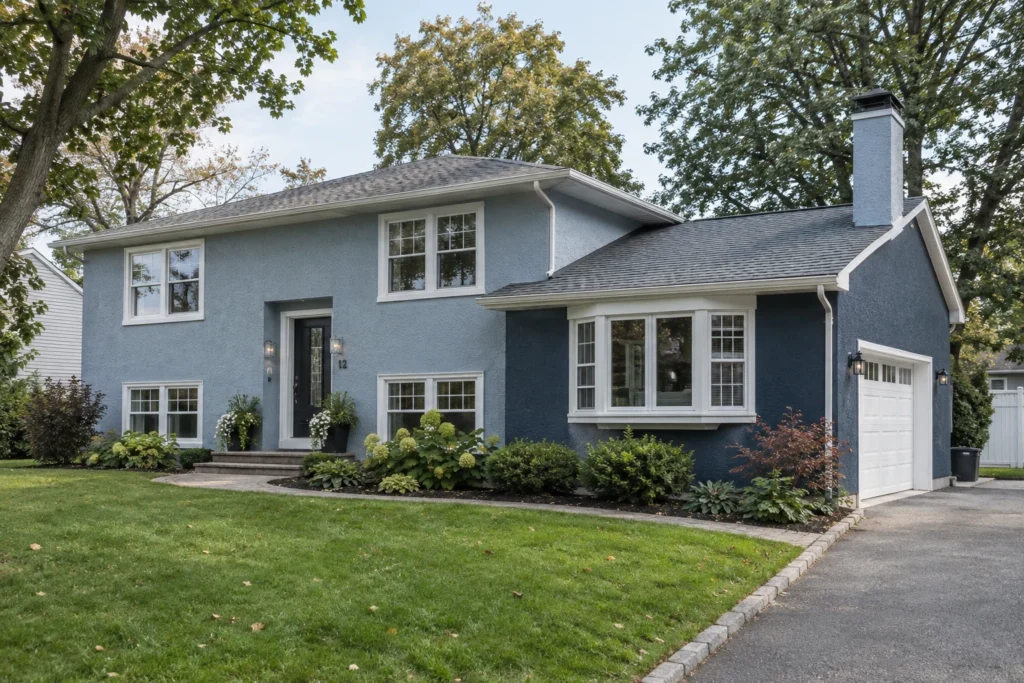
12. Near-White Blue Stucco With a Charcoal Roof
A near-white blue suits homeowners who want a light facade with a cooler cast than cream or beige. A charcoal roof provides enough contrast to keep the house from looking washed out.
This combination is worth testing on a contemporary house with a pitched roof and a simple front. The wall color may appear almost white in direct sunlight and more noticeably blue in shade. Compare it with the actual window frames before deciding whether separate painted trim is necessary.
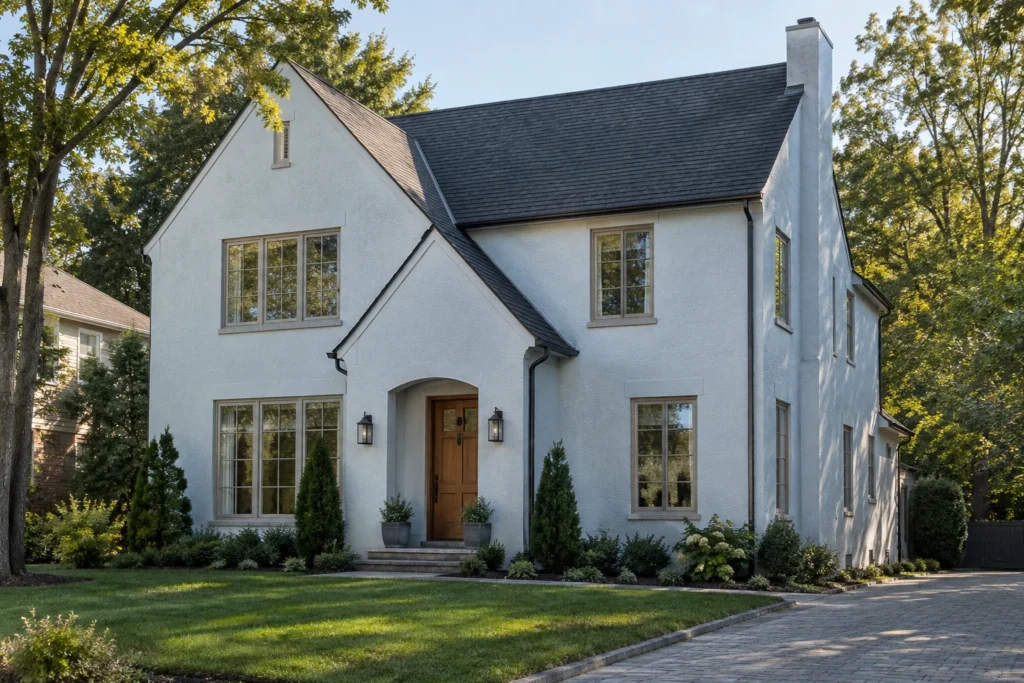
13. Slate Blue Stucco With a Gray-Brown Garage Door
When a garage occupies a large part of the front of the house, its color deserves as much attention as the front door. Slate blue walls and a muted gray-brown garage door can soften the contrast between those large surfaces.
Choose a gray-brown shade that works with the existing stone or paving. Make the front door stand out with wood, lighting, or a small covering above it. This helps visitors find the entrance and keeps the garage from dominating the house.
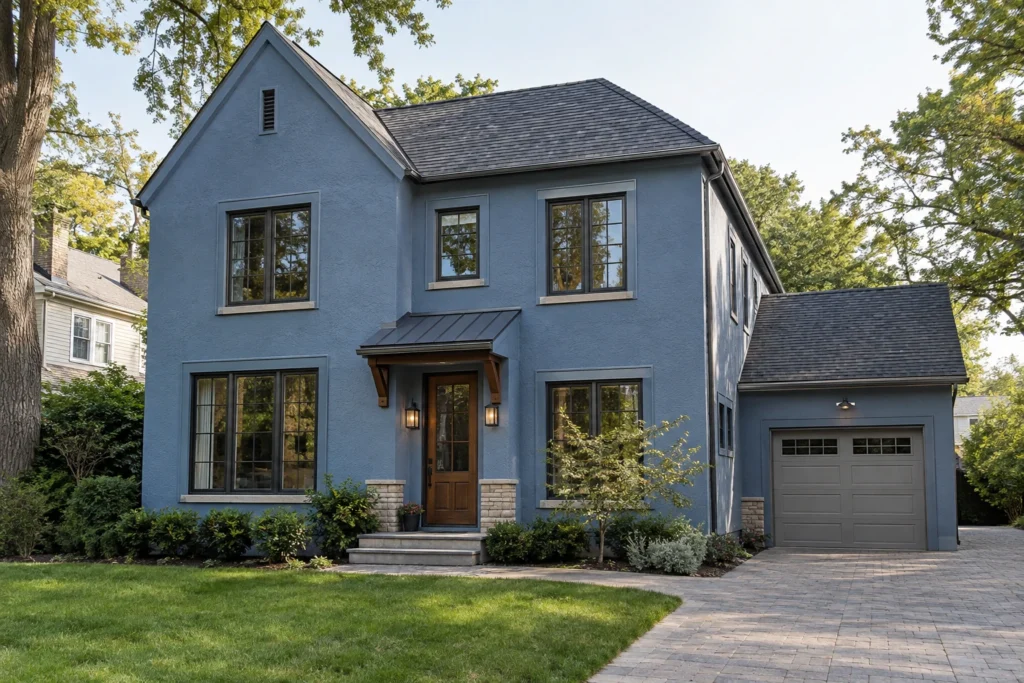
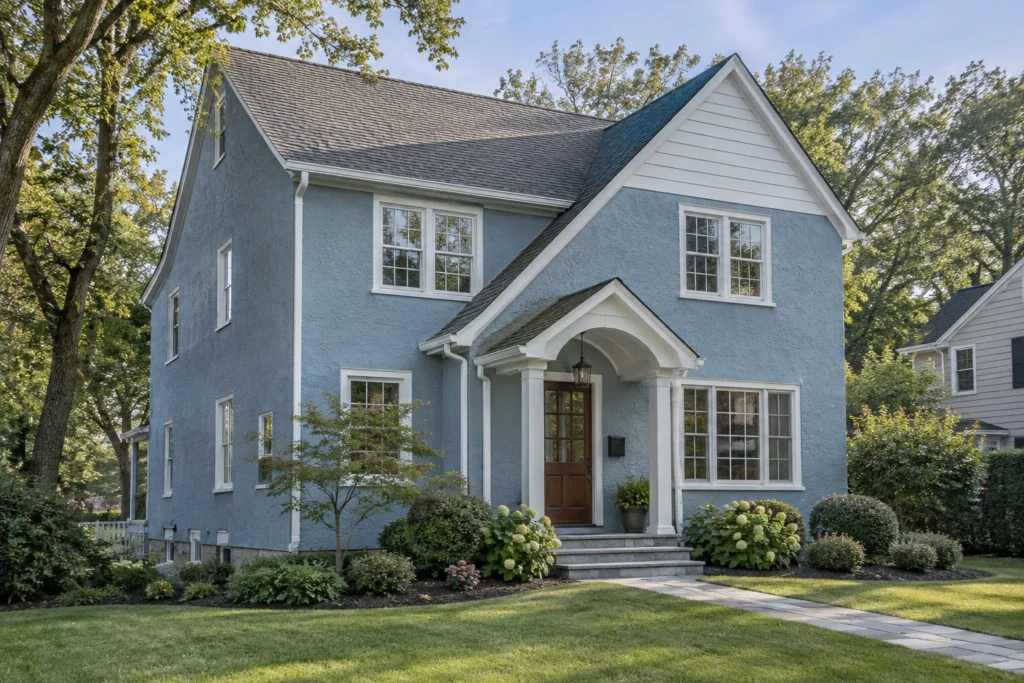
14. Sky Blue Stucco With White Siding Accents
A mixed-material facade can combine sky blue stucco on the main walls with white siding on the triangular wall beneath a pitched roof or on an upper section set back from the main wall. The change between smooth and rough surfaces gives each part of the house a clear identity.
Use siding where the architecture already provides a logical transition. Repeating small patches of white across every wall can make the exterior look busy. On an updated suburban house, one white section beneath a pitched roof and a matching porch detail may provide enough contrast.
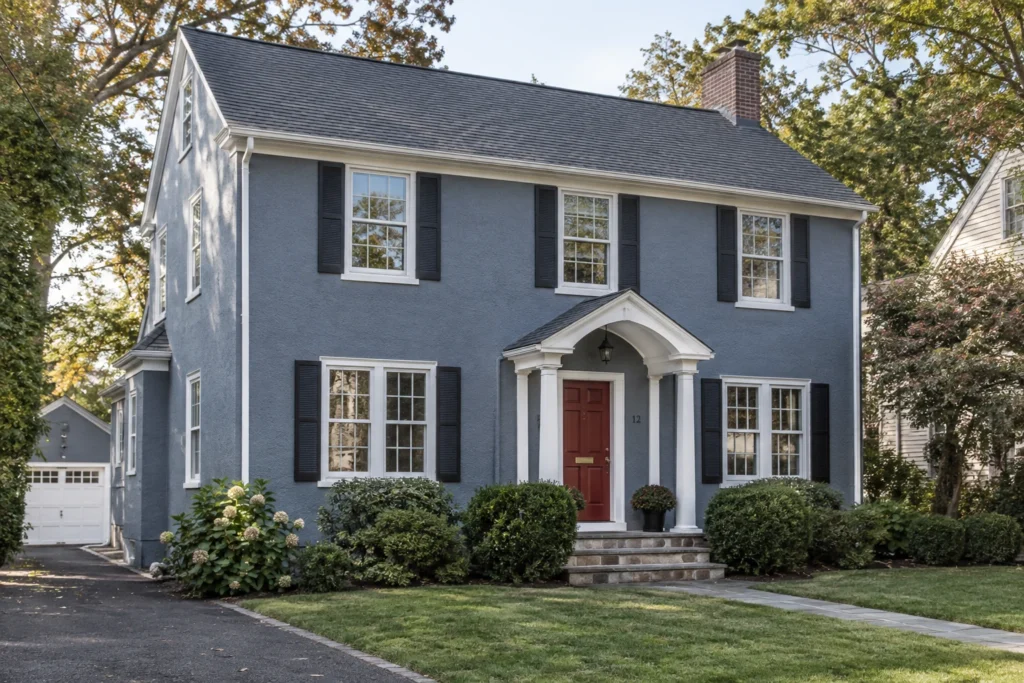
15. Blue-Gray Stucco With a Deep Red Front Door
A deep red door can provide a focused accent against blue-gray stucco. This is particularly useful on a compact Colonial where the entrance sits at the center of an otherwise regular facade.
Choose a red that works with any existing brick. A door with a brown or burgundy influence will create a different result from a bright primary red. Keep the trim and accessories restrained so the entrance remains easy to identify.
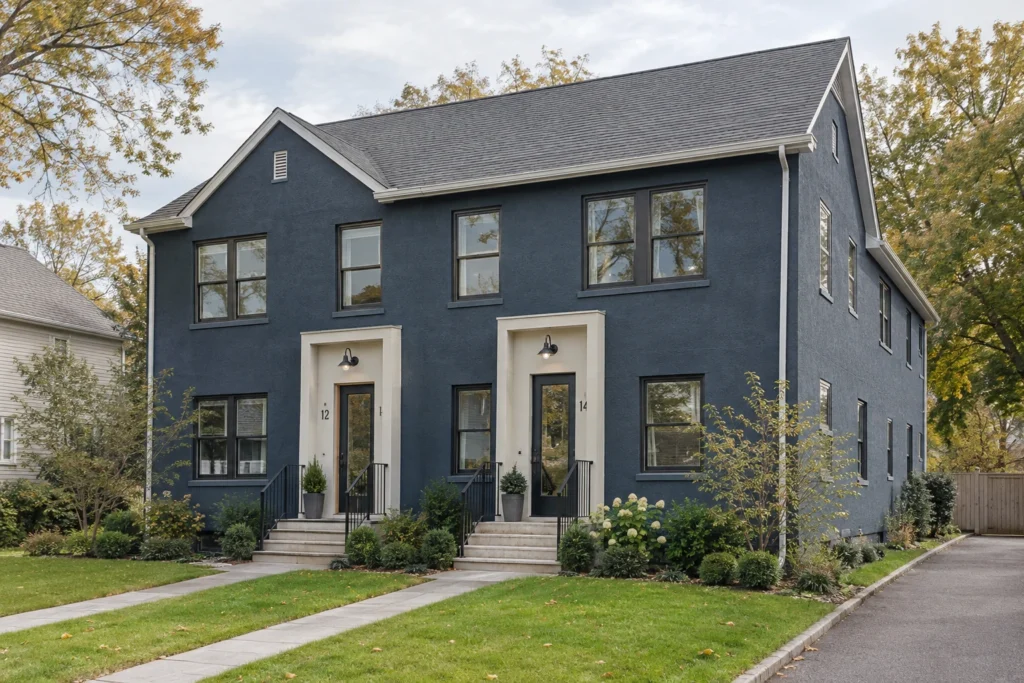
16. Navy Stucco With Light Entrances on a Modern Duplex
On a modern duplex, navy stucco can connect the two homes visually while light-colored walls around each entrance make the two front doors easy to identify. Repeated windows, matching lights, and consistent trim help the building feel coherent.
Use the light color on a clearly defined part of the building, such as an entrance set back from the main wall or a frame that extends out around the doorway. Avoid scattering pale rectangles across the facade. The same approach can work on a small townhouse building, provided your contractor confirms that the dark finish is suitable for the exterior.
Compare Blue Stucco Color Combinations
Use this table to narrow your shortlist around materials you already have. Each combination still needs an exterior sample.
| Blue Stucco Shade | Materials to Pair With It | What to Check First |
|---|---|---|
| Light blue | White trim, gray shingles, natural wood door | Whether the blue looks too bright beside the existing white |
| Blue-gray | Black windows, charcoal roof, gray stone | Whether the sample turns purple or loses its blue character in shade |
| Navy | Cream trim, wood door, pale entry surround | Whether the dark shade and chosen paint or finish are suitable for your exterior |
| Dusty blue | Brown shingles, off-white trim, warm paving | How the blue looks directly beneath the brown roof |
| Denim blue | Red brick, cream trim, neutral roof | The subtle colors in the brick and the material between the bricks |
| Muted blue-green | Bronze windows, off-white trim, natural wood | Whether the color reads as blue, teal, or green outdoors |
| Near-white blue | Charcoal shingles, pale gray trim, wood accents | Whether there is enough contrast with the windows and trim |
Check Your Exterior Before Choosing Dark Blue
Before choosing navy or another dark blue, ask your contractor to check the existing exterior and recommend a suitable paint or finish. Two walls that look similar can be built from different materials and may need different products.
Some stucco-style exteriors have foam insulation beneath a thin protective surface. The manufacturer may limit which dark colors can be used on these walls. For example, Sto’s color guidance includes restrictions for certain insulated exteriors. Your contractor should check the instructions for your home before ordering the finish.
You do not need to identify the materials yourself. Ask a straightforward question: “Is this shade suitable for my exterior, and which product should we use?” Confirm the answer before approving the color.
The condition of the wall matters, too. Peeling paint, loose areas, stains that keep returning, or cracks that reopen should be checked before repainting. If you notice these problems, arrange stucco damage repair before changing the color.
How to Test Blue Stucco Colors Before Committing
A useful sample should answer more than whether you like the blue. It should show how the complete combination behaves on your house.
- Shortlist three distinct options. Compare a lighter blue, a muted blue-gray, and a deeper shade rather than several nearly identical chips.
- Use the intended product and surface finish. Ask for a sample with the same paint or finish and the same smoothness or roughness planned for your walls. A flat paper color card cannot show exactly how the color will look on stucco.
- Compare fixed materials together. Place the samples where you can judge them beside the windows, roof edge, brick, or stone.
- Check sunny and shaded areas. Look at the samples in direct sun, under an overhang, and during overcast conditions. Review them at more than one time of day.
- Look at the house from normal viewing distances. Examine the texture nearby, then step back to the sidewalk or driveway.
- Approve all the colors together. Write down the manufacturer, product, color code, surface finish, and the colors for trim, doors, and other details.
For a New Jersey home, consider both the open, leafless view of the property and the more shaded summer setting. A dark facade partly screened by trees can make a very different impression from the same house viewed across an open lawn.
Before work begins, confirm that:
- The chosen blue is available in the paint or finish planned for your exterior.
- Your contractor has confirmed that the color is suitable for your exterior.
- The sample has the same smooth or rough finish planned for the walls.
- Existing damage and moisture concerns have been addressed.
- The trim, garage door, and front door have been considered together.
Choose the combination that works with the house you have, then confirm it with a physical sample. If you are planning a color change, ZD Stucco Repair’s stucco painting and color-matching services can help you move from a shortlist to a suitable finish for your exterior.
Frequently Asked Questions
What Color Door Goes With a Blue House?
Choose the door color according to the contrast you want and the materials around the entrance. Wood or a warm neutral can connect blue walls with brown roofing or stone. A deeper red can create a focused accent.
Compare the door sample at the entrance itself. A color that looks clear in open daylight may appear much darker beneath a porch.
Does Dark Exterior Paint Fade Faster?
Fading can be more noticeable on dark paint, but color alone does not determine how long it will last. The paint ingredients, the amount of direct sunlight, and the condition of the wall all matter.
Sherwin-Williams’ guidance on fading explains that strong sunlight, unsuitable coloring ingredients, and a powdery residue on aging paint can cause the color to fade or look lighter. Ask the supplier how the specific outdoor paint and shade perform over time.
Does Dark Paint Make a House Hotter?
Dark exterior paint usually absorbs more energy from sunlight than light-colored paint, so the wall surface can become warmer. How much this affects rooms indoors depends on how the walls are built, their insulation, how much sun they receive, and the local climate.
Berkeley Lab’s explanation of cool surfaces also explains that some dark paints contain special ingredients that reflect part of the sun’s energy that we cannot see. The shade alone cannot tell you how warm a wall will get or whether your energy bills will change.
Can You Paint Stucco?
Yes. Stucco in good condition can often be painted with an exterior paint suitable for that surface. Before painting, the wall needs to be cleaned and prepared, damaged areas repaired, and any ongoing water problems addressed.
Your contractor should check the existing surface and how the exterior is built before recommending a product and preparation steps. Our stucco painting service information explains the considerations involved in changing or renewing the color.
What Color Trim Goes With a Blue Stucco House?
White is a useful starting point for the borders around windows and doors and the boards along the roof edge. It creates a clear contrast with light blue, blue-gray, or navy walls. Cream or off-white can look softer beside a brown roof or beige stone, while light gray is worth testing with pale blue walls and a gray roof.
Compare the trim color with both the blue wall sample and your existing window frames. Check the samples outdoors in sunlight and shade, then step back to see whether the window and door borders stand out enough. Keep the trim color consistent around the house for a coordinated look.