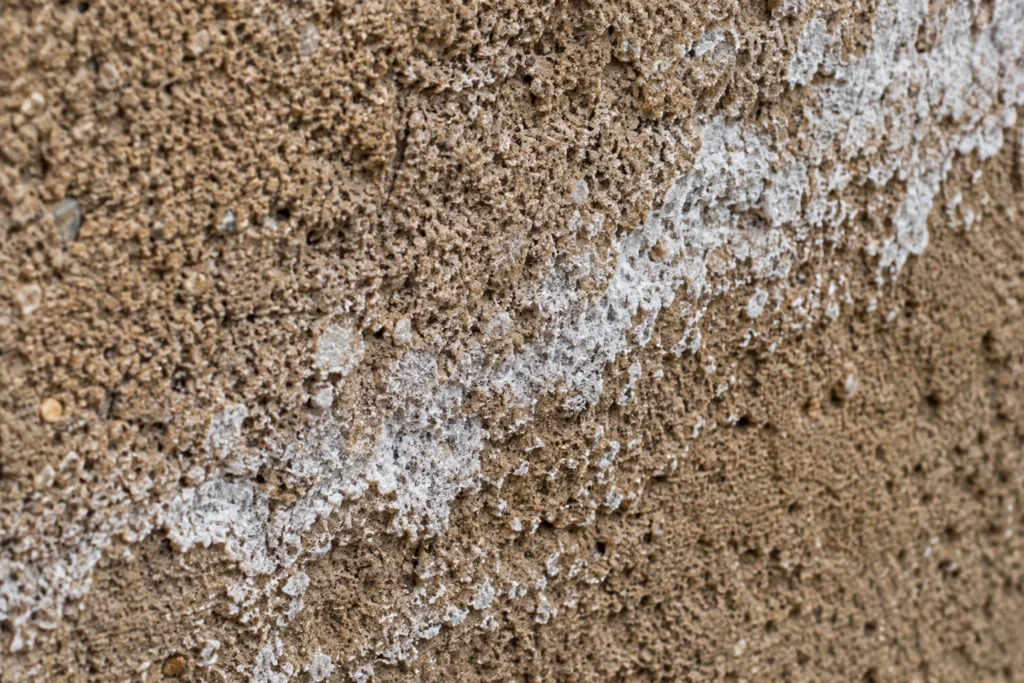
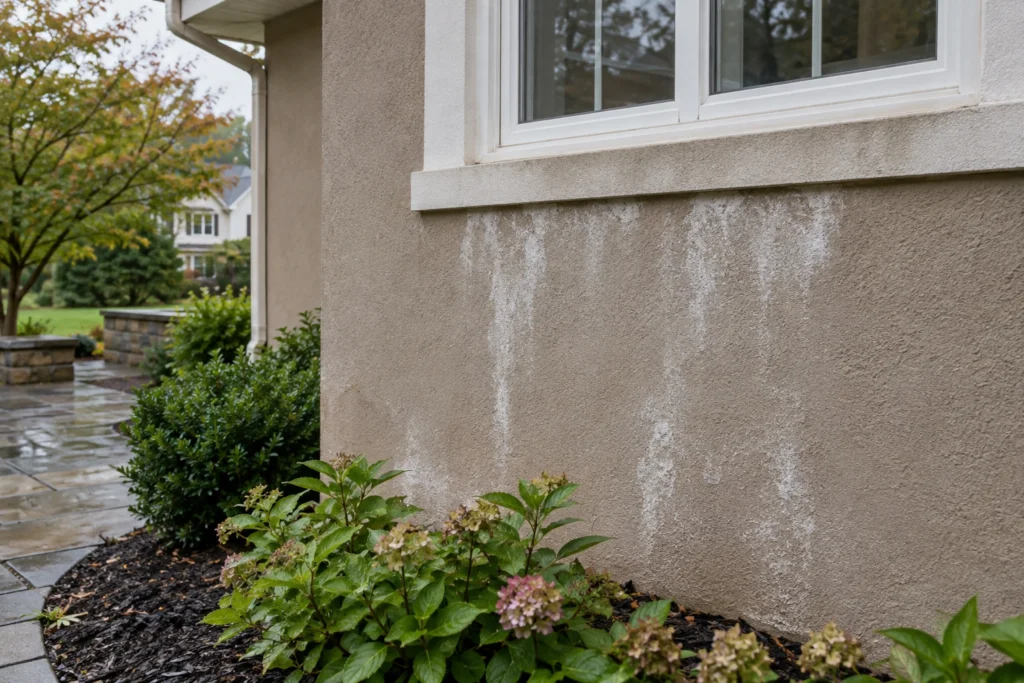
White spots on stucco may be efflorescence: mineral deposits left behind when moisture moves through cement-based material and evaporates. Light, loose deposits can sometimes be removed with gentle brushing and an appropriate rinse. Dense crusts, painted surfaces, and damaged finishes need a more specific approach.
Before cleaning, identify the surface and look for the source of moisture. A white deposit alone does not prove that the wall is leaking internally or needs replacement. However, recurring deposits with cracking, peeling, or other signs of deterioration deserve closer investigation.
What Causes Efflorescence on Stucco?
Efflorescence develops when water dissolves minerals within a material, carries them toward the surface, and evaporates. The remaining deposits can form a powdery haze, small crystals, or white streaks.
The process needs three things:
- Soluble minerals in the material or introduced from another source.
- Moisture that can dissolve and transport them.
- A path through which the moisture can reach an evaporating surface.
Stucco has small pores that allow moisture movement. The presence of a deposit therefore does not automatically establish an installation defect.
The Stucco Manufacturers Association explains two forms of efflorescence. Primary efflorescence appears during curing as new material releases moisture. Secondary efflorescence occurs when cured material goes through repeated wetting and drying.
These categories describe how deposits develop. They do not tell you, by themselves, whether moisture has reached the sheathing or framing behind the exterior.
Not Every White Mark Is Efflorescence
A white patch can come from the finish itself, a mineral deposit, or biological growth. Cleaning products intended for one condition may be ineffective or unsuitable for another.
For example, Sherwin-Williams describes paint chalking as fine powder produced when a paint film weathers. That differs from minerals being carried to the surface by water.
Use appearance as a starting point for assessment, not a definitive test.
| What You Notice | Possible Explanation | What to Check |
|---|---|---|
| Loose white powder or crystalline streaks | Efflorescence or another mineral deposit | Recent wetting, the age of the stucco, and where deposits return |
| A dense white crust that resists gentle brushing | A harder mineral accumulation, including calcium carbonate | Deposit composition and cleaning compatibility before stronger treatment |
| Fine powder across a weathered painted surface | Paint chalking | The condition of the coating and its preparation requirements |
| Patchy or fuzzy-looking material in a persistently damp area | Biological growth or a crystalline deposit with a similar appearance | Have uncertain deposits identified before choosing a cleaning method |
Wetting a patch is not a reliable identification test. Some deposits dissolve readily, others do not, and wetting can change how a surface reflects light. A mark that temporarily disappears has not necessarily been removed.
If biological growth is suspected, follow an appropriate approach to mold on stucco rather than treating it as a salt-cleaning job.
Why White Deposits Often Appear After Rain
A wall may look relatively uniform while wet, then show white streaks as it dries. Water can mobilize minerals within the cement-based layers and leave them at the surface during evaporation.
Potential sources of repeated wetting include rainfall, irrigation overspray, leaking gutters, and water entering around building details. New construction can also contain moisture from mixing and installation.
Cool weather can make deposits more noticeable. Sika Senergy’s technical bulletin explains how slower evaporation can allow dissolved minerals to reach the outer surface before the water evaporates.
For New Jersey homeowners, seasonal exposure is worth recording. Rutgers’ climate overview describes substantial differences between coastal and inland conditions, including winter weather and coastal storms. Note whether a particular wall develops deposits after rain, snowmelt, or irrigation instead of assuming that every property has the same moisture source.
Check the Wall Before Cleaning
Take photographs before disturbing the deposits. Include a close view and a wider view showing nearby windows, roof connections, downspouts, and the base of the wall.
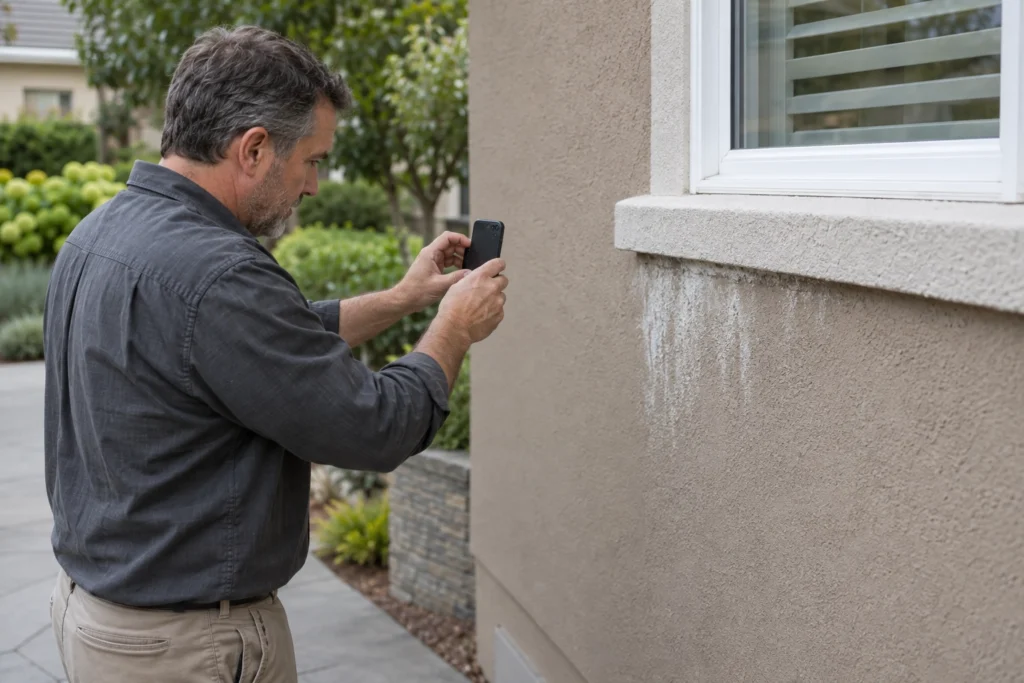
Record when the marks appeared, whether the stucco is new, and whether the same area has been cleaned before. This gives you a useful comparison if the deposits return.
Arrange an assessment before washing if you see:
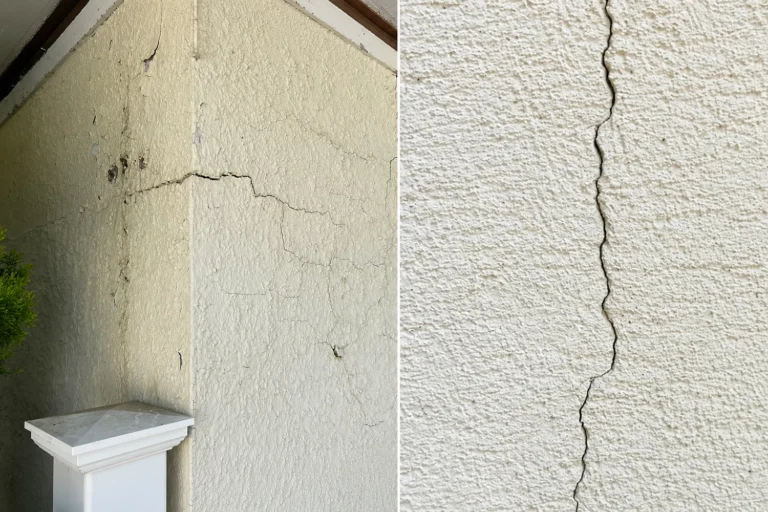
- Open cracks, missing finish, or exposed underlying layers.
- Blisters, bulging, or sections separating from the wall.
- Repeated deposits around an opening or roof connection.
- Indoor dampness or staining near the affected area.
- A surface that remains wet when surrounding areas have dried.
These observations help determine whether cleaning is appropriate. Do not scrape through paint, cut into the wall, or force off loose sections to investigate hidden moisture.
How to Remove Efflorescence from Stucco
Start with the least aggressive method compatible with the finish. A small, accessible area of sound cement stucco may be suitable for careful homeowner maintenance. Unknown coatings, fragile surfaces, extensive deposits, or work above safe ground-level reach call for professional help.
1. Identify the Finish and Check Its Instructions
Confirm whether the surface is unpainted cement stucco, painted stucco, an acrylic finish, or EIFS, an exterior insulation and finish system.
A cleaner approved for bare masonry may affect paint or an acrylic finish differently. Installation records, coating labels, and manufacturer guidance can help identify the appropriate method.
2. Test Gentle Brushing on a Small Area
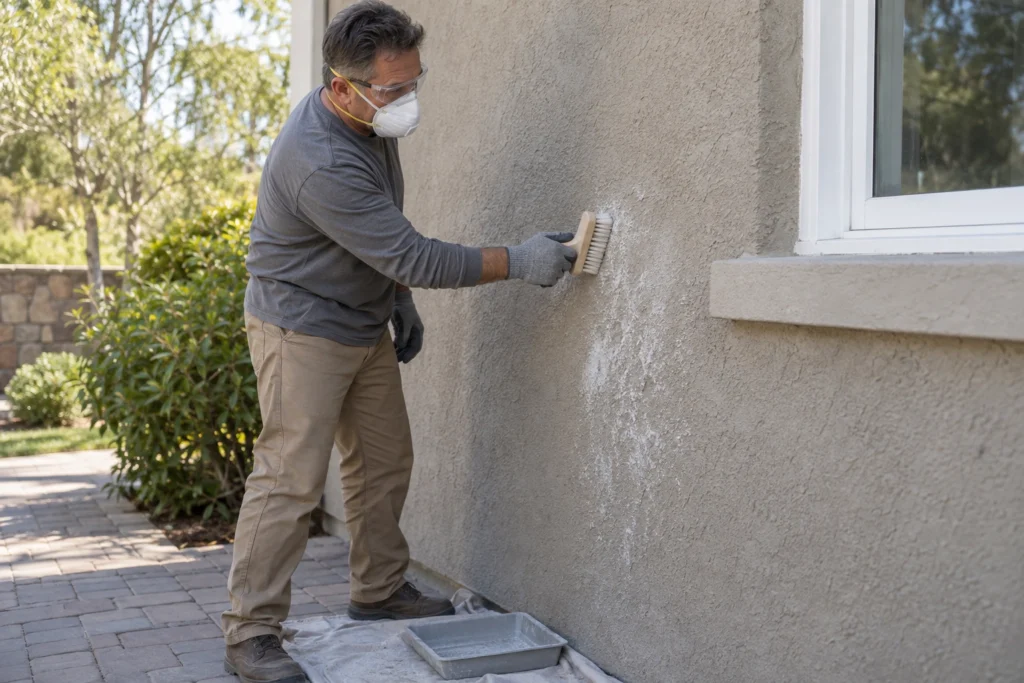
For confirmed loose mineral deposits on a sound surface, test light dry brushing with a suitable nonmetal brush. Avoid aggressive scrubbing and stop if the finish sheds grains, changes texture, or loses color.
Limit airborne dust and use appropriate protective equipment. If the material may be mold rather than mineral residue, do not dry-brush it.
Collect loosened material instead of leaving it where runoff can carry it back against the wall.
3. Rinse Only as the Surface and Method Permit
Where rinsing is approved, use a controlled application of clean water. Avoid directing water into openings, cracks, or vulnerable joints.
Extra pressure is not a dependable solution to a stubborn deposit. It may damage the finish or introduce more water. Likewise, simply wetting salts and allowing them to dry in place may leave the deposit visible again.
4. Get Specific Advice for Persistent Deposits
Some mineral accumulations, including calcium carbonate crusts, are difficult to remove with brushing and water. That does not mean an acid cleaner should be the automatic next step.
Dryvit’s efflorescence-cleaning instructions treat acidic cleaning of heavy deposits as a limited situation requiring manufacturer guidance. Those instructions apply to its finishes, not every textured wall.
Confirm the exact product, permitted dilution, protective equipment, contact time, and rinsing procedure. Never mix cleaning products or improvise a neutralizing solution.
5. Inspect the Dry Surface
Let the test area dry before judging the result. Check for remaining deposits, color changes, and damage to the finish.
If the method works without affecting the surface, continue only within the manufacturer’s instructions. If it does not, stop and reassess. Repeated chemical applications can create a larger appearance problem than the original stain.
The choice between cleaning and further assessment depends on both the deposit and the wall.
| Approach | When It May Help | Important Limit |
|---|---|---|
| Gentle dry brushing | Loose mineral deposits on a sound, compatible surface | Stop if the finish erodes; do not dry-brush suspected mold |
| Controlled rinsing | Removing loosened or water-soluble residue where rinsing is permitted | Added water can contribute to further deposits; avoid forced water entry |
| A compatible specialty cleaner | Identified deposits that resist a gentler approved method | Product approval, a test area, and complete label instructions are necessary |
| Professional assessment | Recurring deposits, uncertain materials, or visible deterioration | The findings should determine whether cleaning, repairs, or further investigation is needed |
How to Reduce Recurring Efflorescence
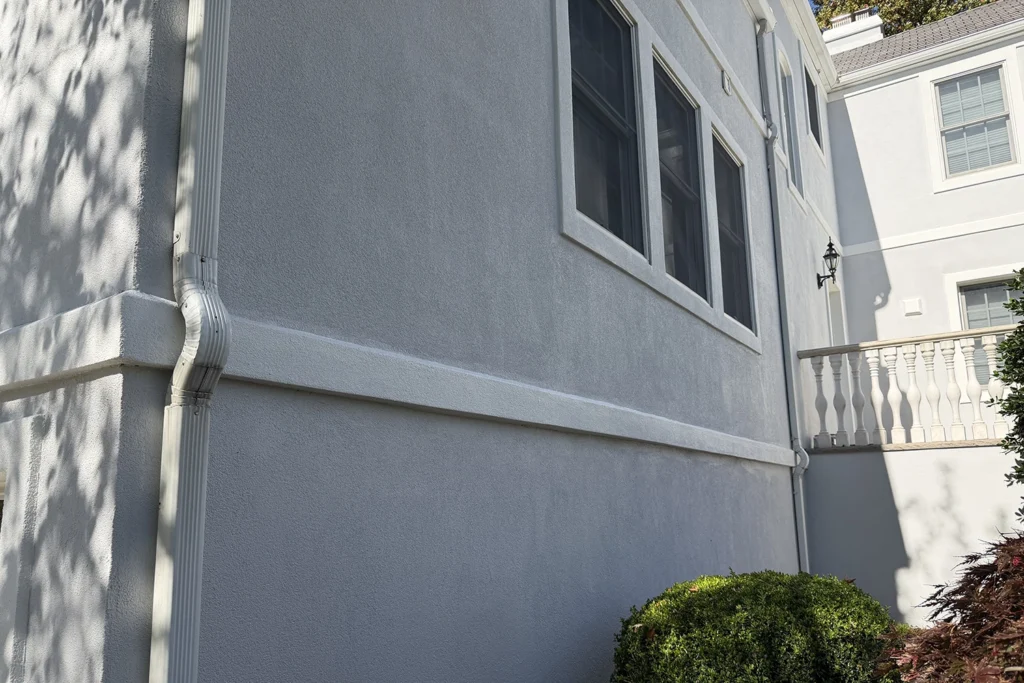
The practical aim is to reduce avoidable wetting while preserving the wall’s ability to drain and dry.
Begin with maintenance you can observe:
- Repair overflowing gutters and leaking downspouts.
- Redirect sprinklers that repeatedly wet the facade.
- Address leaking outdoor faucets and other concentrated water sources.
- Keep soil, mulch, and debris away from the wall’s drainage outlets.
- Have damaged flashing and sealant joints evaluated.
- Follow the stucco manufacturer’s curing and weather-protection requirements during new work.
Do not fill every opening along the bottom of the wall. On a drainable stucco assembly, the weep screed provides an outlet for water. The Building America Solution Center illustrates how flashing and stucco drainage work together.
What About Paint or a Clear Sealer?
A compatible coating or water repellent may be part of a maintenance plan, but it should be selected for the actual assembly. It cannot substitute for correcting a defective flashing detail or another active moisture source.
The wall must also meet the coating manufacturer’s preparation, dryness, and curing requirements. Sika notes that mineral deposits can appear even through acrylic finishes or paint, so a newly coated surface is not proof that the underlying process has stopped.
When Returning Deposits Need Further Investigation
A repeat visit should answer more than whether the wall looks white again. Compare the location, extent, and timing of the deposits.
For example, if a small patch returns only where a sprinkler strikes the wall, correcting that exposure provides a useful first step. If deposits accompany peeling around a window and an indoor stain, the investigation needs to extend beyond surface cleaning.
Neither example establishes the condition of concealed materials without assessment.
For recurring deposits or suspected leakage at a New Jersey property, ZD Stucco Repair’s water infiltration and stucco leak repair service is a relevant next step. Share photographs, the timing of the problem, and details of any previous cleaning or coating work.
The findings should guide the repair scope. White deposits alone are not enough to justify replacing an entire facade.
Frequently Asked Questions
Is Efflorescence Mold?
No. Efflorescence consists of mineral deposits, while mold is biological growth. However, color and texture alone may not reliably distinguish efflorescence from white mold.
Both can be associated with moisture, and they can occur near one another. If identification is uncertain, have the material assessed before brushing or applying chemicals.
Is Efflorescence Dangerous?
A mineral deposit alone does not establish that a building is unsafe. The more important questions are whether moisture is damaging the wall and whether the proposed cleaning method is suitable.
Avoid breathing dust from unknown residue or deteriorating finishes. Acid cleaners introduce separate handling risks and should only be used with confirmed compatibility and the required precautions.
Will Efflorescence Go Away on Its Own?
Some loose deposits can diminish through normal weathering, particularly as new materials dry. Dense deposits may persist, and further wetting can bring additional minerals to the surface.
There is no dependable timetable for every wall. Observation is appropriate only when the surface is sound and there are no unresolved signs of a moisture problem.
Will Vinegar Remove Efflorescence?
Vinegar may dissolve some mineral deposits because it is acidic. That does not make it suitable for every stucco finish.
It can affect the material or coating as well as the deposit. Use it only if the relevant manufacturer explicitly permits that method, including its concentration and rinsing requirements. Do not assume that a household product is harmless to an exterior finish.
Can You Paint Over Efflorescence?
Remove the deposits, address the moisture source, and prepare the surface before painting. Efflorescence under paint can interfere with a lasting finish, and covering the mark does not stop mineral movement.
Once the wall is suitable for coating, choose a compatible primer and finish. Our stucco painting service can help with preparation and coating selection.
Does Efflorescence Smell?
Efflorescence itself is not a source of the musty odor associated with damp materials or mold. A musty smell near white deposits should prompt a separate investigation.
Smell is not a reliable identification test. EPA’s guidance on hidden mold explains that an unexplained moldy odor can warrant investigation even when the source is not visible.